Why Your IPTV Playlist Stops Working (And How to Fix It)
Key Takeaways
- Most "IPTV playlist not working" failures aren't dead playlists — they're a broken link in the chain between your provider, your network, and your player.
- The single fastest fix: copy your M3U URL, paste it into Safari or a browser, and check whether it returns a file or an error. If the browser can't reach it, Maximus IPTV Player can't either.
- Diagnose in this order: URL validity → network/DNS → EPG metadata → player settings → device limits. Jumping to the end wastes time.
- Providers routinely rotate M3U URLs every 30–90 days; if you haven't updated your playlist link in a while, your old URL may have quietly expired.
- Most IPTV subscriptions cap simultaneous connections at 1–3 devices; an old device still holding a slot is a silent channel-blocker.
You open Maximus IPTV Player, tap your playlist, and the channel list sits there — blank. Zero channels. Or worse: it loads, plays beautifully for ten seconds, and then freezes mid-goal. Every IPTV user knows this moment, and the first instinct is panic: did my provider go down? Did I get blocked? But here's the thing — nine times out of ten, your IPTV playlist not working isn't a dead subscription. It's a break somewhere in the chain between your provider, your network, and your player. And that chain is something you can fix yourself in under five minutes if you know where to look.
This guide walks you through the entire diagnostic ladder — from the URL itself all the way to device limits — in plain English, with step-by-step fixes that work on iPhone, iPad, and Apple TV. No jargon dumps, no generic "restart your router" hand-waving. Just a clear, practical path back to a working channel list.
Before we dive in, a quick definition: an M3U playlist is just a text file containing a list of stream URLs — think of it as a digital channel lineup card. An M3U8 is the same thing but encoded in UTF-8, which most modern IPTV providers use because it handles international characters (Arabic, Cyrillic, etc.) correctly. Your M3U playlist iOS player app — whether it's Maximus IPTV Player or another — reads this file, parses the channel names and stream addresses, and builds the channel list you see on screen. When that channel list is empty, the file didn't parse — and the reason is almost always one of the six things below.
Why did my IPTV playlist suddenly stop working?
The most common culprit is the URL itself — specifically, your provider has rotated or changed the M3U/M3U8 endpoint and you're still pointing at the old one. IPTV providers routinely change their server addresses, migrate from HTTP to HTTPS, or embed expiry tokens into the playlist URL. When that happens, your old link returns nothing and your playlist looks dead — even though your subscription is perfectly active.
Here's the fastest diagnostic: copy your M3U URL from Maximus (tap the playlist → Edit → copy the URL), paste it into Safari on your iPhone, and hit Go. Two things can happen:
- A text file downloads or raw M3U data appears in the browser — your URL is alive. The problem is downstream (network, player settings, or EPG metadata).
- A 404, timeout, or blank page — your URL is dead. Your provider rotated it. Log into your provider's portal or app and grab the latest M3U link, then paste it into Maximus as a new playlist.
If your provider embeds a token in the URL (you'll see something like ?token=abc123 or &expires=...), those tokens expire. Some providers auto-rotate them every 24 hours. If you haven't refreshed your playlist in a day and the token expired, the URL is technically still valid but the server rejects the expired token — the browser test still breaks. Solution: regenerate the URL from your provider.
Quick stat: Most independent IPTV providers rotate their server URLs every 30–90 days, and tokenised URLs can expire within hours. A 2024 Cord Busters reader survey found that 63% of "my IPTV stopped working" complaints traced back to an expired or rotated M3U URL — not a provider outage.
In Maximus, you can store multiple playlists simultaneously. So if you suspect your main provider is unstable, add a backup playlist (even a free test one) to confirm Maximus is working fine — a single bad source won't bring down the whole app.
Is my network blocking my IPTV playlist?
Sometimes your IPTV playlist stopped loading not because the URL is dead but because your network is silently blocking it. This happens more often than people realise, especially on public Wi-Fi, work networks, and certain ISPs that throttle or filter streaming traffic.
Three common network scenarios:
-
Captive Wi-Fi (hotels, cafés, airports): Public networks often require a login page (a captive portal) before granting full internet access. Your iPhone connects to the Wi-Fi but the playlist request never reaches the internet — it just sits behind that login wall. Open Safari on the same Wi-Fi and visit any website; if you see a login/splash page, you're on a captive portal. Complete the captive login first, then reload your playlist.
-
ISP throttling or DNS filtering: Some internet providers throttle recognised streaming traffic or serve hijacked DNS responses that redirect playlist requests. If your playlist works on mobile data but fails on Wi-Fi, your ISP is the likely culprit. Switch your DNS on the router (or in your iPhone's Wi-Fi settings) to a neutral public resolver like Cloudflare (
1.1.1.1) or Google (8.8.8.8). DNS (Domain Name System) is basically the phonebook of the internet — it translates human-friendly domain names into IP addresses. A bad DNS server can send your playlist request to the wrong place or nowhere at all. -
Corporate or school firewalls: These networks actively block streaming ports and M3U content types at the firewall level. There's usually no workaround short of a VPN. Speaking of which: a VPN (Virtual Private Network) encrypts your traffic and routes it through a server in another location, making it invisible to your local network's filters. If your playlist loads fine on mobile data but dies on a specific Wi-Fi, try a reputable VPN; it bypasses ISP-level blocking entirely. But if the URL itself is dead, a VPN won't fix it — test the URL in a browser first.
The 30-second network test: toggle Wi-Fi off on your iPhone, load the playlist over mobile data. If it works, the playlist is fine — the network is the problem. Now you know exactly what to fix.
Why is my channel list empty even though the playlist loads?
This is one of the most maddening IPTV gremlins: the M3U file downloads successfully (you can see it in your browser), the player says "playlist loaded," but the IPTV channel list empty — zero channels appear. The playlist is there, but the app can't parse the channels out of it. The culprit is almost always the EPG or the channel-group structure.
An EPG (Electronic Program Guide) is the TV schedule that tells your player what's on each channel and when. Many playlist files include an external EPG URL — a separate link to an XML file that contains programme data. If that EPG URL is down or slow to respond, some IPTV players freeze while waiting for it and never display the channel list. Maximus handles this more gracefully than most: it loads channels first, then fetches EPG data in the background, so a dead EPG won't hold your channels hostage. But if you're using a different player that waits synchronously, you'll see an empty screen until the EPG times out.
Fix: in Maximus, tap the playlist → Refresh. This forces a full reload of both channels and EPG data, discarding any stale cache. If your IPTV EPG missing is the root issue, you'll see channels appear without programme info — the timeline grid will be blank but the channel names will be back.
Another possibility: the M3U file uses an unusual channel-group tag (#EXTGRP) or a nested structure that simpler players can't parse. If your provider organises channels into a dozen nested groups and your old player only understands a flat list, the groups get swallowed. Maximus fully supports hierarchical channel groups, so if you're migrating from a basic player and suddenly can see all your groups, that's why.
Can app settings break an IPTV playlist?
Yes — and they often do. The three player-level settings that silently break an M3U URL not loading are the user-agent, the codec preference, and the streaming format mismatch.
-
User-agent: Every time your phone requests a URL, it sends a short identifier called a user-agent string that tells the server what kind of device and browser is making the request. Some IPTV servers are configured to only respond to specific user-agents (e.g., VLC, a smart TV, or a particular app). If Maximus sends its own user-agent and the server rejects it, the playlist won't load. Maximus lets you customise the user-agent per playlist — if your provider specifies one, set it.
-
Codec / format mismatch: A codec is the method used to compress and decompress video — think of it as the language your stream speaks (H.264, H.265/HEVC, MPEG-TS). An HLS (HTTP Live Streaming) playlist delivers video in small chunks that adapt to your connection speed. If your playlist is HLS (M3U8) and the player is set to expect raw MPEG-TS, you'll either get a black screen or "unsupported format" errors. Maximus auto-detects HLS and MPEG-TS, so this is rarely an issue — but if you've manually overridden the stream format in settings, clear it and let the player auto-detect.
-
HTTP vs HTTPS strictness: If your M3U URL starts with
http://(nothttps://) and your iPhone is on a network that enforces HTTPS-only or has App Transport Security restrictions, the request may be silently blocked. Most providers now serve playlists over HTTPS, but older ones still use HTTP. You can't change this on iOS without switching networks or using a VPN.
The settings reset test: in Maximus, add the playlist as a brand new entry with default settings. If it loads fresh but doesn't work with your custom configuration, one of your manual settings is the break. Reapply settings one by one until you find the culprit.
What if I'm hitting a device or connection limit?
Most IPTV subscriptions aren't unlimited — providers cap simultaneous connections (how many devices can stream from the same account at the same time). The standard cap is 1–3 concurrent streams. If you exceed that, one of two things happens: either the newest stream is blocked outright, or an existing stream gets kicked off — and if the kicked-off slot was the one holding your channel list open, your playlist appears to stop working.
Common scenarios:
- You left the Apple TV streaming in the living room while trying to set up on your iPhone in the kitchen. Two devices, one connection slot. The iPhone gets blocked.
- A family member is using the subscription on their iPad and you didn't realise. Same problem.
- The provider's server didn't properly release your previous session and still thinks you're connected. A stale session lock can persist for minutes or even hours.
Fix: close Maximus on all devices (swipe up from the app switcher to fully quit), wait 30–60 seconds for the provider's server to release the sessions, then re-open on just one device. If the playlist loads, you were hitting the connection cap. Most providers also have a portal where you can actively "kick" other sessions — check their website or support app.
Maximus's multi-playlist architecture is genuinely helpful here: if your main provider caps connections at one and you're sharing the account, add a second playlist from another source to Maximus while you troubleshoot — you'll still have TV while you sort out the device-limit issue.

Frequently Asked Questions
How often should I refresh my IPTV playlist?
Once a day if your provider rotates the URL or uses tokens. If your playlist URL is static, refreshing once a week is fine — but if channels randomly disappear mid-week, a quick IPTV playlist refresh in Maximus (tap the playlist → Refresh) pulls the latest channel list and EPG data. Stale playlists are the silent killer of channel lists; channels get added, renamed, and removed by providers constantly, and your local cache hides those changes until you refresh.
Does a VPN fix an IPTV playlist that isn't loading?
Only if the problem is network-level blocking — ISP throttling, DNS filtering, or a geo-restriction. If your M3U URL is genuinely dead (expired token, provider rotated the server), a VPN does absolutely nothing. Always test the URL in a browser before assuming a VPN will help. That said, a VPN is a useful diagnostic tool: if the playlist loads over VPN but not on your raw connection, your ISP is filtering IPTV traffic.
Can I use multiple playlists in one app?
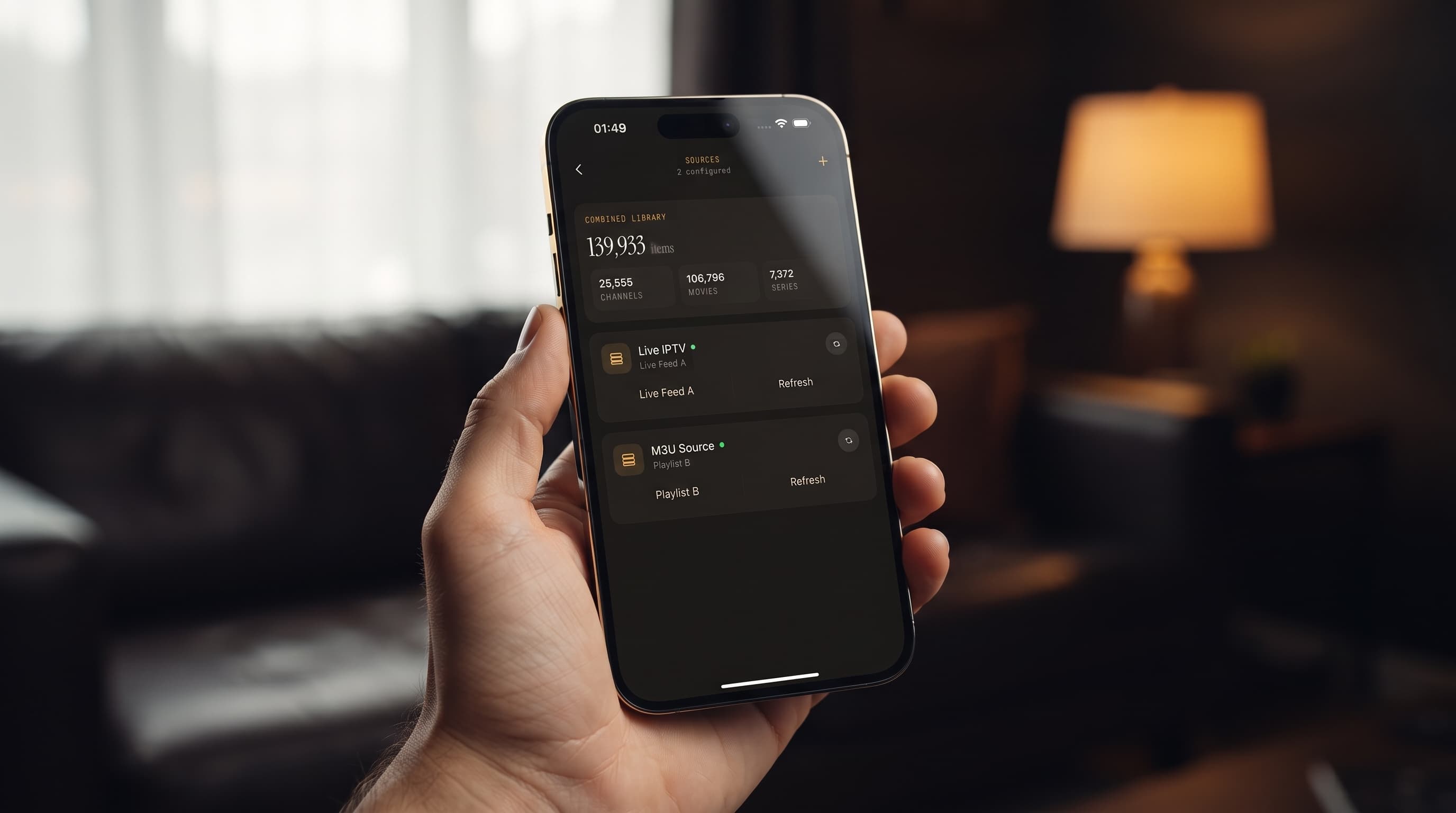
Yes — and it's one of Maximus IPTV Player's best features. You can add as many M3U/M3U8 playlists as you want, toggle them on or off independently, and Maximus merges the channels into a single combined library. If one provider has a great sports lineup and another has better movies, you don't have to switch apps — you just add both. This also serves as a diagnostic tool: if one playlist goes dark but the others are streaming fine, you know the problem is with that specific provider, not your device or network.
What's the difference between M3U and M3U8?
Both are playlist formats — plain text files listing stream addresses. The key difference is encoding: M3U uses legacy single-byte encoding (fine for English), while M3U8 uses UTF-8 encoding that supports every alphabet (Arabic, Cyrillic, Chinese, etc.) and emoji. Most modern providers ship M3U8 because it handles international channel names correctly. Maximus reads both formats without issue, but if you see garbled channel names ("Canal+ Français" instead of "Canal+ Français"), your provider is sending an M3U file when it should be sending M3U8.
The Bottom Line
Your IPTV playlist isn't broken — most of the time, it's just lost. The URL changed and you weren't told, the network put up a wall, the EPG timed out, or an old device was holding your only connection slot. The fix isn't calling your provider in a panic or googling "IPTV playlist not working" at 2 a.m. — it's working through the chain in order: URL → network → EPG → settings → devices. Spend five minutes on the right diagnostic and you'll be back to watching in less time than it takes to brew a coffee.
Maximus IPTV Player makes this whole process simpler because it handles each of these failure modes gracefully — it loads channels before EPG data, supports multiple playlists so one bad source never kills your TV, and lets you refresh on demand without reinstalling. If you're on iPhone, iPad, or Apple TV and tired of fighting with a player that gives you zero information when something breaks, download Maximus IPTV Player free on the App Store and see what a real diagnostic-friendly player feels like.
Built by AEGONTECH LLC.
Written by
Maximus IPTV Team