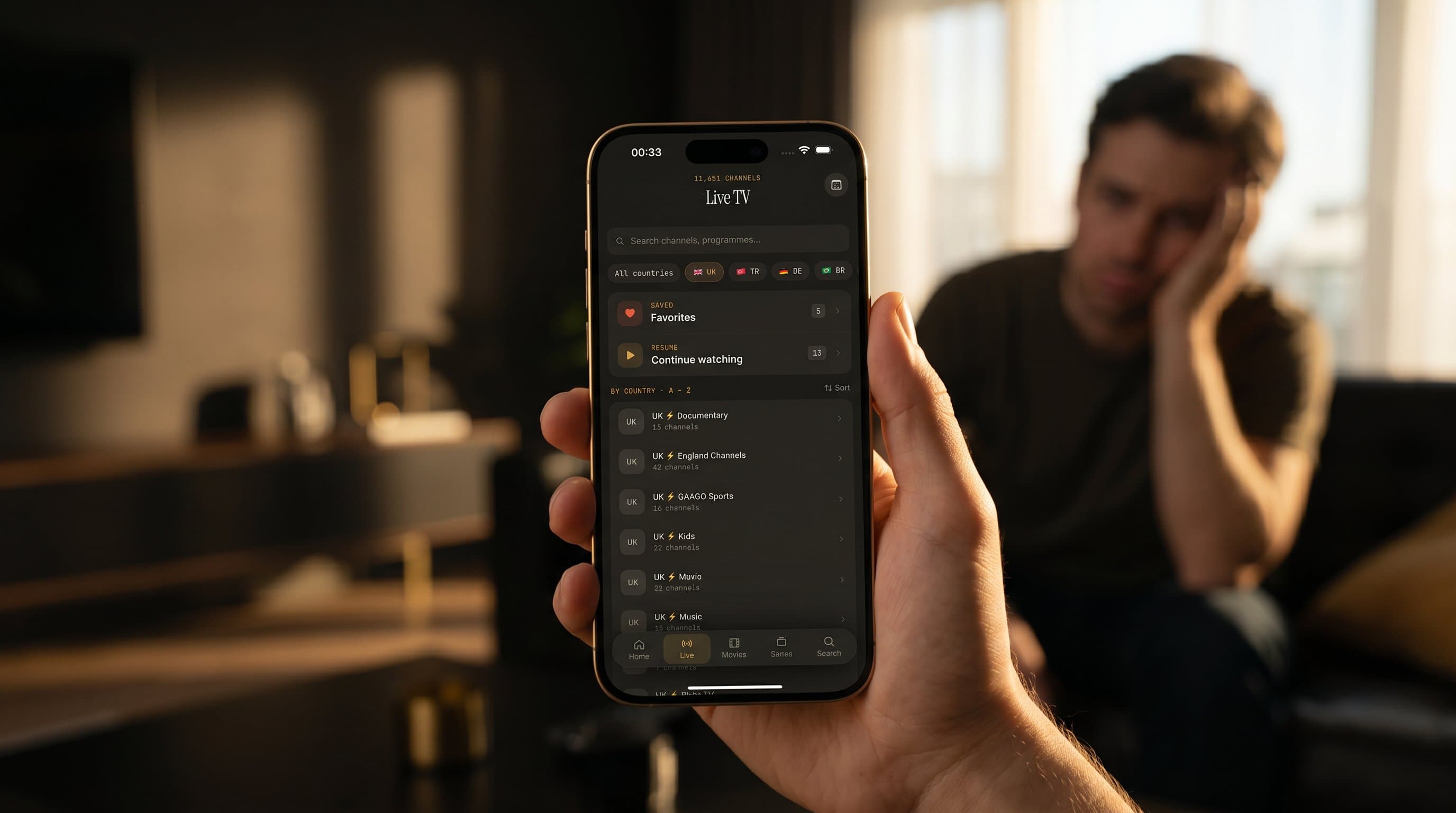
Why IPTV Buffering Ruins Your Streaming Experience (And How to Make It Stop)
You're eight minutes into a tied match. The striker is through on goal — and the spinner appears. Your iPhone freezes, the audio cuts out, and the moment is gone. That is IPTV buffering, and it ruins live TV on your iPhone, iPad, and Apple TV. The good news: it almost always comes down to four things — your network, your playlist, your device, and your IPTV player iOS app. Maximus IPTV Player is the best IPTV player for iOS, free on the App Store, and it's built to fix that fourth one. Here's how to stop the spinner.
Almost every case of IPTV buffering on iOS traces back to one of four causes: your network, your playlist source, your device, or the player app you're using. You can audit the first three in an evening. For the fourth, switch to a player engineered for live IPTV — not a generic video player with "M3U support" bolted on.
Key Takeaways
- Buffering on iOS IPTV apps is almost always caused by one of four things: network, playlist, device, or player.
- Live IPTV streams in short chunks (usually 2–10 seconds each); a single dropped chunk stalls playback.
- 4K IPTV needs roughly 25 Mbps of clean, steady throughput — not just "fast Wi-Fi."
- The right IPTV player iOS app handles dropped segments, rebuffers, and codec switching invisibly.
- Maximus IPTV Player is built for buffer-free streaming on iPhone, iPad, and Apple TV, with full M3U/M3U8 and EPG support and 4K playback.
Why does my IPTV keep buffering? The plain-English answer
IPTV keeps buffering when your iPhone, iPad, or Apple TV runs out of video data to play before the next chunk arrives. Live IPTV isn't a single big file you're downloading — it's a stream of short video segments, and the player needs to keep a small "buffer" of those segments in memory at all times. The moment the next segment is late, the playback stalls, you see the spinner, and your evening falls apart.
The good news: that delay is almost always explainable, and in most cases fixable without buying new hardware.
What actually causes IPTV to buffer?
IPTV buffers when one of four things fails: your network, your playlist source, your device, or your player app. IPTV is more fragile than Netflix or YouTube for a simple reason — those services run on giant, geographically distributed CDNs and have spent a decade tuning their players. A typical IPTV playlist is a list of channels streamed from a single server (or a small cluster) somewhere in the world, and your iPhone has to reach it over the public internet in real time. Here are the four categories of failure, and how they overlap.
1. The network: how your video actually gets to your iPhone
Most IPTV streams use a protocol called HLS (HTTP Live Streaming) — that's Apple's streaming format and the de-facto standard for live IPTV. HLS works by chopping the live broadcast into tiny segments (typically 2 to 10 seconds long, with 6 seconds being the Apple-recommended default) and serving them over plain HTTP. Your player downloads segment 1, plays it, downloads segment 2, plays it, and so on.
That's elegant, but it means any of these network problems will stall the stream:
- Insufficient bandwidth. A 1080p IPTV stream needs about 5–8 Mbps of clean, sustained throughput. A 4K IPTV stream needs closer to 25 Mbps. If your connection is slower than that — or fast on paper but shared across a household — you will buffer.
- Jitter and packet loss. "Fast Wi-Fi" with 200 Mbps on a speed test can still be a terrible streaming connection if the actual delivery is bursty. Even 1–2% packet loss on a real-time stream causes visible stutter.
- Wi-Fi vs cellular. A weak Wi-Fi signal — two rooms away from the router, behind a thick wall — is one of the most common IPTV buffering causes on iPhone. Cellular can be more stable in that case, depending on your carrier.
- Household congestion. The average household now has 15–20 connected devices, per Deloitte's 2023 Connectivity & Mobile report. If a 4K Netflix stream, a PlayStation download, and a cloud backup are all happening on the same Wi-Fi as your IPTV, something has to give.
2. The playlist source: not all IPTV streams are equal
Your player is only as good as the source it's pulling from. Common playlist-side problems:
- The origin server is overloaded. Free or cheap IPTV providers run on tiny servers with too many users. Peak-time buffering is a classic symptom.
- Geographic distance. A server in Frankfurt will buffer more on a phone in São Paulo than one in Lisbon, all else equal.
- Inconsistent transcoding. Some sources flip between bitrates mid-stream; a good player absorbs the change, a bad one stalls.
- Stale or dead links. Channels disappear, URLs change, and a player that doesn't gracefully skip a dead channel can freeze the whole list.
A good IPTV player for iOS can't fix a fundamentally broken source, but it can fail over gracefully instead of locking up.
3. The device: hardware and iOS limits
Modern iPhones and iPads are powerful little computers, but live 4K HEVC decoding is genuinely hard work, especially on older devices. Things that hurt:
- Background apps and thermal throttling. A 30-minute 4K stream on a hot iPhone in direct sunlight will throttle the CPU/GPU and start dropping frames.
- Outdated iOS. Apple's HLS stack gets better with every major iOS release. Older iOS versions handle adaptive bitrate less smoothly.
- Low-power mode. Convenient for battery life, brutal for sustained 4K decoding.
- Apple TV storage full. A near-full Apple TV quietly cripples app performance.
4. The player app: where most "buffering" problems are actually fixed
This is the category you can fully control, and it's the one most people underestimate. Two players receiving the same stream from the same Wi-Fi can have wildly different experiences.
What separates a buffer-prone IPTV app from a buffer-free one:
- Aggressive, smart buffering. Prefetch the next 2–3 segments so a single slow one doesn't stall playback.
- Adaptive bitrate switching. Drop from 4K to 1080p the instant the network wobbles, and climb back up when it recovers — without you noticing.
- Codec and hardware decode support. Modern H.264 and HEVC hardware decode, plus the right variant of HLS, matter a lot on Apple silicon.
- Playlist resilience. Skip a dead channel in milliseconds instead of freezing the player.
- A sane, modern player UI. A clean EPG, a fast channel zapper, and proper M3U/M3U8 parsing reduce the time you spend fighting the app and increase the time you spend watching.
How do you fix IPTV buffering on iPhone, iPad, and Apple TV?
You fix IPTV buffering by working through network → playlist → device → player, in that order, and stopping the moment playback stabilises. Most viewers get all the way through step 4 once and never see the spinner again. Here's the actual sequence to run.
1. Sort your network first.
- Run a speed test on the same Wi-Fi band your device is using. For 4K IPTV, you want at least 30 Mbps headroom on a wired or strong 5 GHz connection.
- Move closer to the router, or switch to 5 GHz instead of 2.4 GHz. Apple TVs are happiest on Ethernet — if yours supports it, use the wired adapter.
- Pause the big bandwidth hogs: cloud backups, game downloads, 4K Netflix on another TV. One device streaming 4K on a shared link is fine; three of them is not.
- If you're on cellular and the stream keeps stalling, try a different carrier or a stronger signal. A VPN can help when your ISP throttles streaming — but pick a low-latency one close to you.
2. Audit your playlist source.
- Try the same channel at off-peak hours. If it buffers then, it's the source, not you.
- If your provider offers multiple regional mirrors, switch to the closest one.
- Drop dead channels from your M3U — a few rotten entries can stall naive players.
3. Tune your device.
- Update iOS / tvOS to the latest stable release.
- Free up a few GB of storage on Apple TV.
- Disable Low Power Mode while watching.
- Restart the app (and the device, occasionally) before assuming it's a network problem.
4. Use a player engineered for it. This is the lever most people miss. A purpose-built IPTV player iOS app like Maximus IPTV Player handles the things above invisibly — prebuffering, adaptive bitrate, dead-channel skipping, codec switching — so the only time you ever see the spinner is on a genuinely bad network.
What makes Maximus IPTV Player different from other IPTV apps on iOS?
Maximus IPTV Player is a player app only, engineered around a single goal: buffer-free live IPTV on iOS — and unlike generic video players, it doesn't bolt M3U support on as an afterthought. It's built by AEGONTECH LLC and free on the App Store for iPhone, iPad, and Apple TV.
What that means in practice:
- Buffer-free streaming is the headline feature. Maximus is engineered around an aggressive, smart prebuffer that keeps a healthy cushion of upcoming HLS segments in memory, so a single slow segment doesn't stall your picture.
- Full M3U / M3U8 playlist support. M3U is the plain-text playlist format IPTV providers use to hand you a list of channels (think of it as a list of streaming URLs and channel names). M3U8 is the same thing, just with the
.m3u8extension that Apple's HLS stack recognises natively. Maximus parses both, handles multi-source playlists, and keeps a clean, searchable channel list. - 4K IPTV playback. Hardware-accelerated HEVC decoding on modern iPhones, iPads, and the Apple TV 4K, so 4K streams don't cook your device or fall apart mid-match.
- Built-in EPG (Electronic Program Guide). EPG is the on-screen "what's on now / what's on next" TV guide. Maximus ships with a fast, beautifully designed EPG that pulls in your provider's XMLTV data, so you can browse what's on without leaving the app.
- AirPlay and a modern Apple TV experience. Cast to your TV with AirPlay, or just open Maximus natively on Apple TV — the same library, the same EPG, the same play queue.
- Parental controls. PIN-protect adult channels or specific playlists, so the kids don't accidentally land somewhere you don't want them to.
- A beautiful, modern interface. Cinematic dark, warm gold accents, a channel zapper that actually zaps. Made by AEGONTECH LLC — the company that decided a player app should look as good as the content it plays.
Maximus is a player, not a content provider. You bring your own legal IPTV subscription or playlist; Maximus plays it. That's an important distinction: the app will never help you find pirated streams, and it shouldn't.

Frequently asked questions
Is there a free IPTV player for iPhone that doesn't constantly buffer?
Yes — Maximus IPTV Player is free on the App Store for iPhone, iPad, and Apple TV and is built specifically for buffer-free IPTV streaming on iOS. Its smart prebuffer absorbs the network blips that stall other players, and it doesn't lock features behind a subscription. For a one-time power-user upgrade, the in-app Max plan unlocks extra playlists and multi-screen features.
What IPTV player works best on Apple TV?
Maximus IPTV Player is the best IPTV player for Apple TV in our (admittedly biased) view, because it ships as a native tvOS app with the same library, EPG, and AirPlay support you get on iPhone and iPad. Most "Apple TV IPTV" experiences are really iPad apps stretched to the TV, with a clunky Siri Remote experience; Maximus is built for the big screen first.
How much internet speed do I need for buffer-free 4K IPTV?
Plan for at least 25 Mbps of clean, sustained throughput for a 4K HEVC IPTV stream, with some headroom for your other devices. 1080p IPTV typically needs 5–8 Mbps. "Fast Wi-Fi" on a speed test isn't enough — what matters is steady, low-jitter delivery to the device doing the decoding. Wired Ethernet on Apple TV is the gold standard.
Can a bad M3U playlist cause buffering on iOS?
Yes — a stale, overloaded, or geographically distant playlist source is one of the top three IPTV buffering causes on iPhone, iPad, and Apple TV. A good player like Maximus IPTV Player will skip dead channels gracefully, but it can't conjure bandwidth the source server isn't delivering. If the same channel buffers at off-peak hours too, the playlist is the problem.
So how do you actually stop the spinner for good?
Buffering turns live TV into a slideshow, and it almost always traces back to one of four things: your network, your playlist, your device, or your IPTV player iOS app. You can audit the first three in an evening. For the fourth, switch to a player that was actually built for live IPTV — not a generic video player with "M3U support" bolted on.
Maximus IPTV Player is free on the App Store for iPhone, iPad, and Apple TV. It supports M3U and M3U8 playlists, includes a proper EPG, plays 4K, has AirPlay and parental controls, and a cinematic dark interface that gets out of the way. Made by AEGONTECH LLC, it's the player the next goal, the next episode, and the next live event deserve.
Download Maximus IPTV Player free on the App Store, bring your own legal playlist, and never see that spinner again.
Written by
Maximus IPTV Team