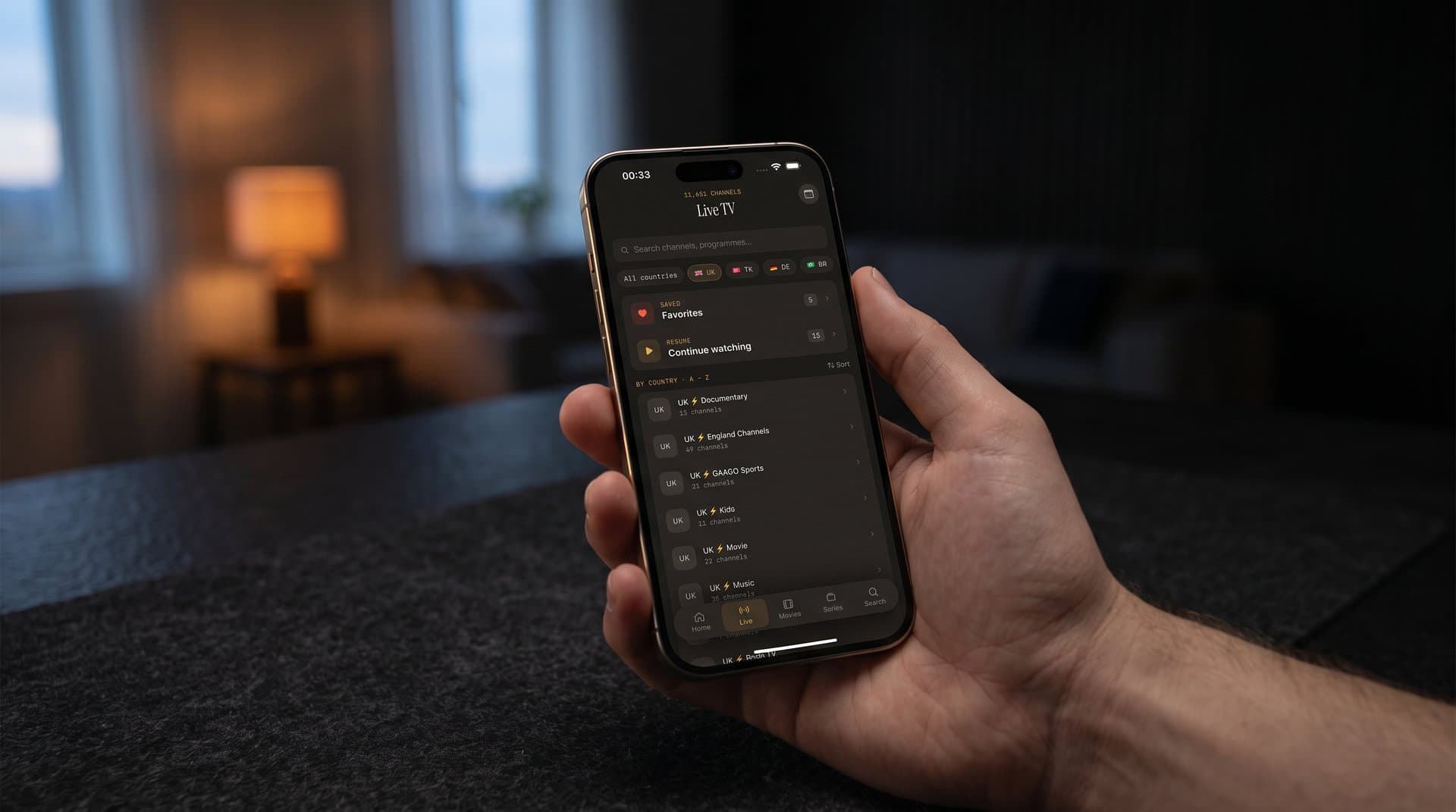
How Much Data Does IPTV Streaming Use? A Maximus IPTV Player Bandwidth Guide
If you've ever watched a live match on your phone and wondered why your carrier's data warning popped up halfway through the second half, you're asking the right question. Maximus IPTV Player is a free-to-download, cross-platform IPTV player available on the Apple App Store (iPhone, iPad, and Apple TV) and on Google Play for Android (phones, tablets, and Android TV / Google TV) — and like any video app, how much data it uses depends heavily on what you're watching and how. This guide breaks down the real numbers behind IPTV streaming, what actually drives data usage up or down inside Maximus IPTV Player, and how to keep watching without blowing through your monthly cap.
To be clear up front: Maximus IPTV Player is a player, not a content source. It streams whatever legal playlist or subscription you connect to it — your own IPTV provider, your own M3U/M3U8 playlist (the standard text-file formats IPTV services use to list channels), or a Stalker Portal connection (a common IPTV middleware protocol). Nothing here endorses or links to pirated streams; this is about managing bandwidth for content you already legally access.
Key Takeaways
- 4K streams typically use 7–9 GB per hour, HD (1080p) around 3 GB per hour, and SD closer to 1 GB per hour — general video-streaming benchmarks that apply to any 4K-capable player, including Maximus IPTV Player.
- Maximus IPTV Player streams over HLS (HTTP Live Streaming), an adaptive protocol that can adjust quality to your connection in real time, which helps avoid constant buffering on shakier Wi-Fi or mobile data.
- Offline downloads (available in Maximus IPTV Player for supported series/VOD content) let you pull episodes over Wi-Fi and watch later with zero live data cost.
- Casting via AirPlay (Apple's screen/media casting for iOS and Apple TV) or Chromecast / Google Cast (available on both the iOS and Android versions of Maximus IPTV Player) still pulls the stream through your phone or router — it doesn't magically reduce data use, but it does move the cost onto your home Wi-Fi instead of mobile data.
- A VPN (Virtual Private Network) adds a small amount of overhead to any connection, IPTV included, but it does not fundamentally change how much video data a 4K or HD stream requires.

How much data does IPTV streaming actually use?
Video data usage scales almost entirely with resolution and bitrate, not with which app you're using. As a general rule of thumb that applies across the streaming industry — and to any 4K-capable app, Maximus IPTV Player included — expect roughly:
- 4K / Ultra HD — around 15–25 Mbps of sustained bandwidth, which works out to roughly 7–9 GB per hour of viewing.
- HD / 1080p — around 5–8 Mbps, or roughly 2–3 GB per hour.
- SD / standard definition — around 1–3 Mbps, or roughly 0.7–1 GB per hour.
If you're watching a two-hour movie in 4K, that's realistically 15–18 GB gone. Multiply that by a household streaming every evening and it's easy to see why cord-cutters start paying attention to their router's data dashboard. Maximus IPTV Player supports 4K playback where your source content and connection allow it, so the ceiling is there — but so is the option to dial it back.
What actually affects data usage inside Maximus IPTV Player?
A few factors matter more than people expect:
- Live TV vs. on-demand. Live channels stream continuously the moment you tune in, so leaving a channel running in the background (say, while you cook dinner) burns data the whole time, even if you're not watching closely. VOD (video-on-demand) content only uses data while it's actually playing or buffering ahead.
- Adaptive bitrate via HLS. Maximus IPTV Player streams over HLS, a protocol that (depending on your source's configuration) can step quality up or down based on your real-time connection speed. This is what keeps a shaky hotel Wi-Fi signal from freezing every ten seconds — the trade-off is a softer picture, not a stalled one.
- Multi-source and channel-group browsing. Scrolling through EPG (Electronic Program Guide — the TV Guide-style grid showing what's on and when) data or channel thumbnails uses comparatively little bandwidth on its own; the real cost kicks in once you actually start playing a stream.
- Device and screen size. A 4K stream on an Apple TV or Android TV connected to a big screen is worth the bandwidth. That same 4K stream on a 6-inch phone screen is often indistinguishable from 1080p to the eye, so this is one of the easiest places to save data without noticing a difference.
Is data usage different on Wi-Fi vs. mobile data?
Technically, no — a 4K stream uses the same amount of data whether it travels over your home Wi-Fi or your carrier's LTE/5G network. What's different is who's counting it and what it costs you. Home broadband plans are frequently unlimited or have very high caps, so a few hours of Maximus IPTV Player in the evening rarely registers. Mobile plans are a different story: many U.S. carriers cap "full-speed" high-definition data at 15–50 GB per month before throttling kicks in, which a single 4K binge session can meaningfully dent.
The practical takeaway: treat mobile data as the resource to protect, and let your home Wi-Fi carry the heavy 4K viewing. If you're watching Maximus IPTV Player on your phone away from Wi-Fi, that's the moment to actively choose a lower resolution or shorter viewing session rather than defaulting to whatever quality autoplay picks.
Can you reduce data usage while traveling or on a limited plan?
Yes, and this is where Maximus IPTV Player's offline download feature earns its keep. For supported series and VOD content, you can download episodes while connected to Wi-Fi — at home, at a coffee shop, wherever — and then watch them later with zero live data cost, whether you're offline entirely or just trying to avoid touching your mobile plan. It's the single biggest lever for anyone who commutes, flies often, or travels somewhere with expensive or unreliable data.
A few habits that help beyond downloads:
- Download before you leave, not after. Queue up episodes the night before a flight or road trip while you're still on solid Wi-Fi.
- Favorite the channels and shows you actually watch. Less scrolling and re-buffering while searching means less wasted data spent loading previews you don't end up watching.
- Check your connection before committing to live TV. If you're on a weak signal, a recorded or downloaded episode will almost always look and play better than a live stream fighting for bandwidth.

Does casting to Apple TV or Chromecast use more data?
Not more, but differently. When you cast from Maximus IPTV Player using AirPlay (Apple's built-in casting protocol, available for iOS and Apple TV) or Chromecast / Google Cast (supported on both the iOS and Android versions of Maximus IPTV Player, not just Android — this is a common misconception), the video stream still has to travel from your original source through your phone or your home network to reach the TV. Casting doesn't add a second copy of the data cost; it just relocates the last leg of the trip from your phone's screen to your television's screen, generally over the same home Wi-Fi.
Where this matters practically: casting a 4K stream to a big screen makes the resolution worth it in a way that watching 4K on a phone often isn't, so if you're going to spend the data, casting is one of the better ways to spend it. Just make sure you're casting over solid Wi-Fi rather than a weak mobile hotspot, or you'll get the buffering-on-the-big-screen experience nobody wants.
Do you need a VPN for IPTV, and does it affect data usage?
A VPN (Virtual Private Network) routes your internet traffic through an encrypted tunnel to a server elsewhere, which can help with general privacy and, in some cases, more consistent routing if your ISP is throttling specific types of traffic. Using one with any streaming app, including Maximus IPTV Player, adds modest encryption overhead — typically in the low single-digit percentage range of extra data — but it does not change the underlying video bitrate. A 4K stream is still a 4K stream with or without a VPN active; what a VPN can change is connection stability and, for some ISPs, whether your traffic gets deliberately slowed down during peak hours. This guide isn't a recommendation to use a VPN to access anything you couldn't legally access without one — it's simply an honest answer to a question a lot of cord-cutters ask.
FAQ
Does Maximus IPTV Player use more data than Netflix or other streaming apps? No. Data usage is driven by resolution and bitrate, not by which app is playing the video. A 4K stream on Maximus IPTV Player uses roughly the same bandwidth as a 4K stream on any other player.
Can I limit Maximus IPTV Player to Wi-Fi only? While Maximus IPTV Player doesn't fabricate a dedicated "Wi-Fi only" toggle beyond what your device's own settings control, most phones let you restrict individual apps' mobile data access at the operating system level (iOS: Settings > Cellular; Android: Settings > Network & Internet > Data usage), which effectively forces Maximus IPTV Player to only stream when connected to Wi-Fi.
Does watching in the EPG guide use data? Browsing the EPG grid itself is lightweight — you're loading schedule text and small thumbnails, not video. Data usage jumps once you actually tap play on a channel or show.
Will downloading episodes for offline viewing eventually fill up my phone's storage? Yes, eventually — downloaded video files are large, especially in HD or 4K, so it's worth periodically clearing episodes you've already watched, the same way you'd manage downloaded content in any streaming app.
Is 4K worth the extra data on a phone screen? Usually not. On a 6-inch display, most people can't visually tell 1080p from 4K at normal viewing distance, so this is an easy place to save data without a noticeable quality trade-off — save 4K for when you're casting to a TV.
Getting the most out of Maximus IPTV Player, data-conscious or not
Managing data usage isn't about watching less — it's about being intentional with the bandwidth you have. Maximus IPTV Player gives you the tools to do that: offline downloads for travel and limited plans, adaptive HLS streaming that adjusts to your connection, and both AirPlay and Chromecast support so you can put the highest-quality stream on the screen that actually deserves it. Whether you're on iPhone, iPad, Apple TV, an Android phone, an Android tablet, or Android TV / Google TV, the same underlying habits — download ahead, save 4K for the big screen, and know when to switch to Wi-Fi — will keep your viewing smooth and your data bill boring.
Maximus IPTV Player is free to download, with an optional premium subscription, on the Apple App Store for iPhone, iPad, and Apple TV, and on Google Play for Android phones, tablets, and Android TV / Google TV.
Written by
Maximus IPTV Team