How to Cast Maximus IPTV Player to Your TV with AirPlay and Chromecast
Watching IPTV on a 6-inch screen is fine for a quick check of the score, but nobody wants to watch a full match or a two-hour movie squinting at their phone. That's where casting comes in, and Maximus IPTV Player — the free iOS IPTV player app for iPhone, iPad, and Apple TV — makes it a built-in part of the experience rather than an afterthought. If you've been streaming your own legal IPTV subscription or M3U playlist through Maximus IPTV Player and wondering how to get it onto the television without buying extra hardware, this guide walks through both major casting paths: Apple's AirPlay and Google's Chromecast.

Key Takeaways
- Maximus IPTV Player supports casting to both AirPlay-compatible devices (Apple TV, AirPlay 2 smart TVs) and Chromecast-enabled TVs and streaming sticks, right from the in-app device picker.
- AirPlay, introduced by Apple in 2010 and upgraded to AirPlay 2 in 2018, mirrors or streams video directly over your local Wi-Fi network with minimal setup.
- Chromecast, which Google launched in 2013, works the same way for TVs and dongles on the Google Cast standard — no separate app installation required on your TV.
- Both casting methods need your iPhone or iPad and your TV (or streaming device) on the same Wi-Fi network — that single detail causes the vast majority of "device not found" issues.
- Live TV and downloaded episodes both cast the same way in Maximus IPTV Player, but a slow connection affects live streams far more noticeably than downloaded content.
What Are AirPlay and Chromecast, and Why Does It Matter for IPTV?
AirPlay is Apple's built-in wireless streaming protocol for iOS, letting an iPhone or iPad send video and audio to a nearby Apple TV or an AirPlay 2-certified smart TV. Chromecast is Google's competing standard, used by Chromecast dongles and by the growing number of smart TVs that build Google Cast support directly into their firmware. Neither one requires cables. Both rely on your device and your TV being on the same local Wi-Fi network so they can find each other and negotiate a direct streaming connection.
For an IPTV player specifically, this matters because IPTV content is typically delivered over HLS (HTTP Live Streaming), a protocol that breaks video into small segments the player downloads and stitches together in real time. Casting adds a second hop — from your phone to your TV — so the quality of your Wi-Fi, not just your internet connection, becomes part of the equation. Maximus IPTV Player handles the handoff, but a weak Wi-Fi signal between your phone and your router (or your router and your TV) is the most common source of stutter after you've cast.
How Do You Cast Maximus IPTV Player to Your TV with AirPlay?
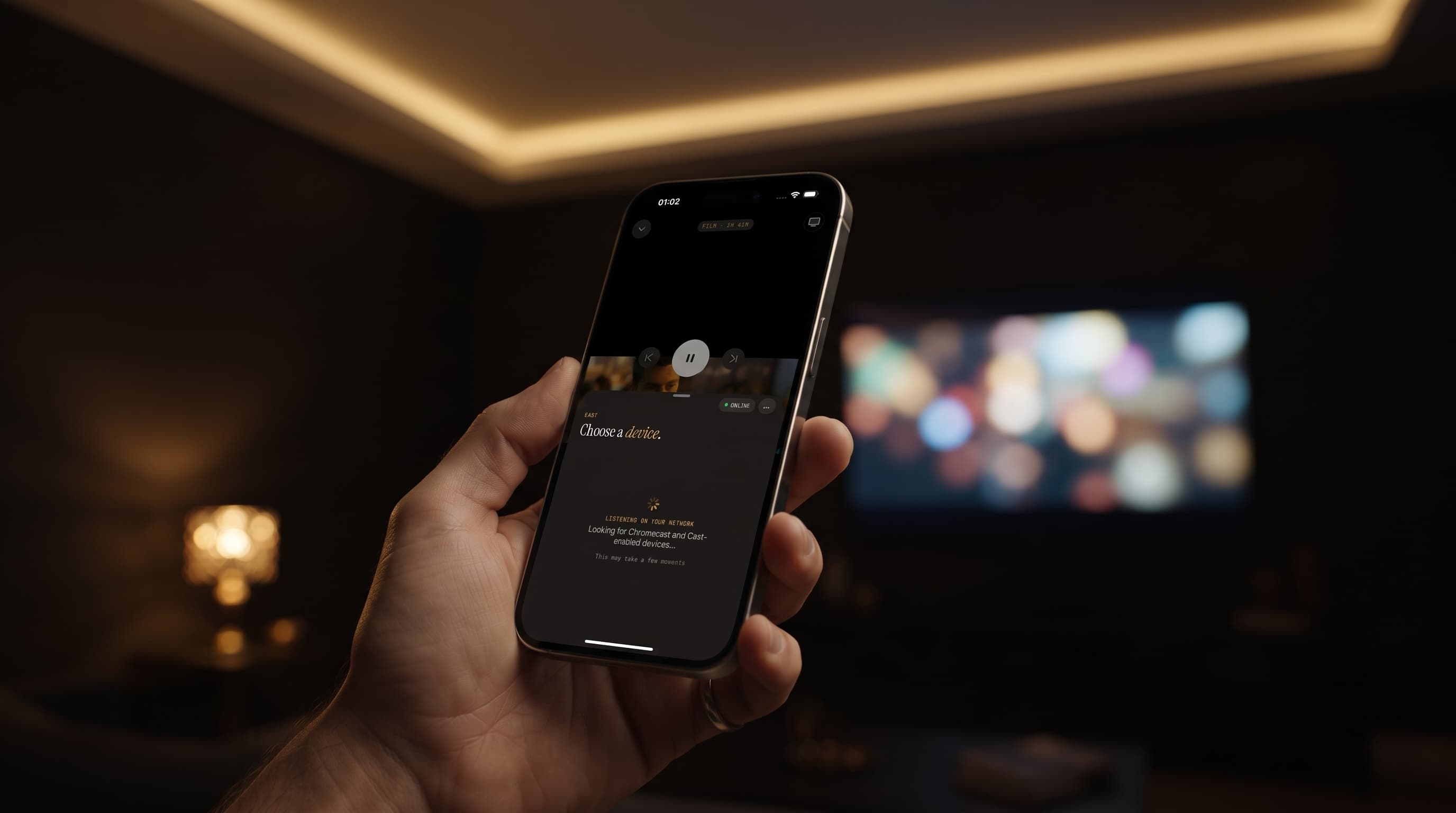
Start playback of any channel or show inside Maximus IPTV Player, then tap the cast icon in the player controls. The app opens a "Choose a device" sheet that lists every AirPlay-compatible device it can see on your network — an Apple TV, an AirPlay 2 smart TV, or in some homes, both. Tap the one you want, and playback hands off to the television within a few seconds. The video keeps playing on your iPhone or iPad's lock screen controls too, so you can pause, skip, or switch channels without picking the phone back up.
One detail worth knowing: AirPlay works over your regular home Wi-Fi, not Bluetooth, so range is roughly whatever your router's Wi-Fi coverage already gives you. If your TV is two rooms away from your router, that's your first troubleshooting stop, not the app.

Can You Use Chromecast with Maximus IPTV Player?
Yes — the same cast icon and device picker in Maximus IPTV Player also lists Chromecast-enabled devices, whether that's a Chromecast dongle plugged into an older TV or a newer smart TV with Google Cast built in. You don't need to install anything separately on the TV side; Maximus IPTV Player's "Listening on your network" step actively searches for both AirPlay and Cast-enabled devices at the same time, then shows you a single combined list to pick from.
This matters for households that mix ecosystems — an iPhone-owning member of the family and a Chromecast-equipped living room TV, for instance. You're not locked into Apple-only hardware just because you're on iOS.
Why Does Casting Sometimes Fail or Buffer?
Three things account for almost every casting problem:
- Different networks. If your phone is on your home Wi-Fi but your TV somehow ended up on a guest network, or if you're on a VPN (a Virtual Private Network, which routes your traffic through a different server and can also change what network your phone "appears" to be on), the two devices can't see each other. Turn off the VPN or make sure both devices are on the identical network name before casting.
- Wi-Fi congestion. IPTV streaming and casting both consume real bandwidth continuously, not in short bursts. On a router already juggling several devices, live 4K playback cast to a TV is the heaviest combination you can ask of it. Dropping to a lower-bitrate stream or moving your router closer to the TV usually resolves it.
- Stale device lists. Occasionally the device picker just needs a refresh — closing and reopening the cast sheet re-triggers the network scan and picks up devices that didn't show up the first time.
If your playlist itself is unstable — channels that won't load at all, not just ones that buffer after casting — that's usually a separate M3U or M3U8 (the playlist file formats IPTV providers use to list channel streams) issue on the source side, worth checking with your provider rather than a casting problem.
Is Casting Different for Live TV vs. Downloaded Shows?
Mechanically, no — the same cast icon and device picker handle both. Practically, yes, in terms of what you'll notice. Live TV has no buffer to draw from if your connection dips, so a rough patch in your Wi-Fi shows up immediately as stutter or a frozen frame. A downloaded episode, saved to your device ahead of time through Maximus IPTV Player's offline download feature, is already sitting on your iPhone or iPad — casting it just streams a local file to the TV, which is generally smoother since there's no live internet stream in the chain at all.
If you know you'll be watching something specific later — a series you've been meaning to catch up on, say — downloading it first and then casting is the more resilient option, especially on a home network that gets crowded in the evenings.
FAQ
Does Maximus IPTV Player require a separate app on my Apple TV to cast? No. AirPlay is built into every Apple TV and AirPlay 2-certified smart TV at the system level — you just need your Apple TV powered on and connected to the same Wi-Fi network as your iPhone or iPad.
Can I use AirPlay and Chromecast on the same TV? Yes, if your TV supports both standards (common on many recent smart TVs) or if you have both an Apple TV and a Chromecast device connected to it. Maximus IPTV Player's device picker will list whichever ones it detects.
Will casting drain my iPhone or iPad's battery faster? Somewhat, since the screen typically stays on to show playback controls and the Wi-Fi radio stays active the whole time. Locking the screen after starting a cast still keeps the stream running on the TV while reducing phone battery use.
Does 4K playback carry over when I cast? Maximus IPTV Player supports 4K playback where your source stream provides it, and casting preserves that resolution if both your Wi-Fi connection and the receiving device (Apple TV, smart TV, or Chromecast) can handle it. A weaker connection may cause automatic quality step-down rather than a hard failure.
Is it legal to cast IPTV content this way? Casting is just a delivery method — it doesn't change the legality of the underlying content. Maximus IPTV Player is a player app for your own legal IPTV subscription or M3U/M3U8 playlist; always source your content from a legitimate, licensed provider.
Bringing It to the Big Screen
Casting turns Maximus IPTV Player from a solo-viewing app into something the whole room can watch, and the setup genuinely is just picking a device from a list — the complexity, when it shows up, almost always traces back to a Wi-Fi network mismatch rather than the app itself. Once your phone and your TV are talking to each other on the same network, AirPlay and Chromecast both hand off playback in seconds and stay out of your way after that. Maximus IPTV Player is free on the App Store for iPhone, iPad, and Apple TV, and the cast icon sits right in the player controls the next time you're ready to move a channel or a show from your hand to your living room.
Written by
Maximus IPTV Team