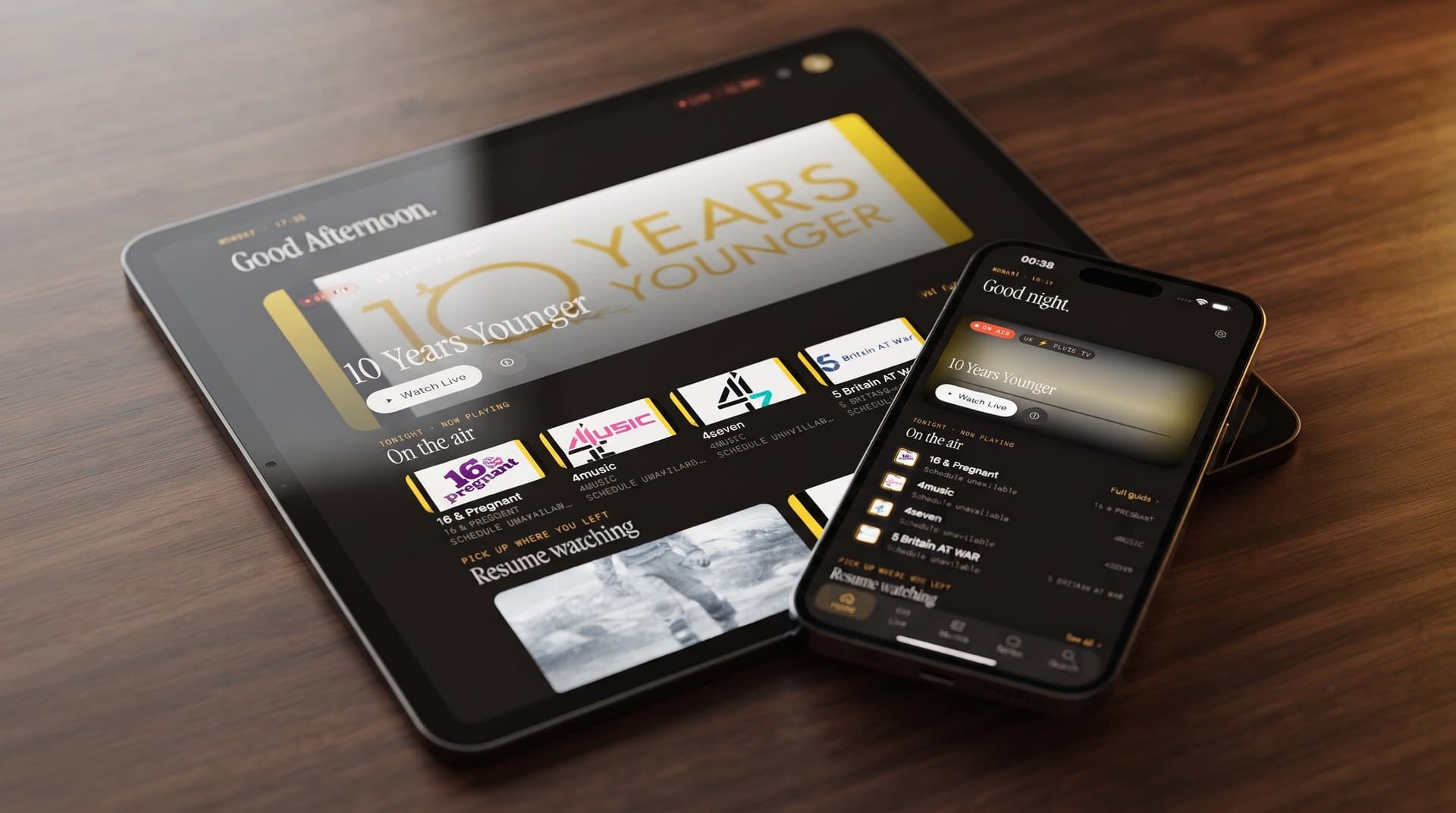
iPhone vs. Android for IPTV: Maximus IPTV Player on Phone, Tablet, and TV
If you have an IPTV subscription and you are deciding whether to watch it on an iPhone or an Android phone, the honest answer is that the platform matters far less than most comparison articles suggest. Maximus IPTV Player ships on both the Apple App Store and Google Play, it is free to download on both, and the core of the app is the same either way: the same playlist formats, the same electronic program guide, the same 4K playback, the same parental controls.
Where the two platforms genuinely diverge is narrower than you would think, and it is not where people usually expect. It comes down to how each ecosystem handles casting, and how each one gets you from a phone screen to the television in your living room.
This guide walks through both, feature by feature, so you can stop guessing.

Key Takeaways
- Maximus IPTV Player is available free on both the Apple App Store (iPhone, iPad, Apple TV) and Google Play (Android phones, tablets, and Android TV / Google TV), with an optional premium subscription.
- Both platforms reach the big screen with a native TV app. Apple TV covers the Apple side; Android TV and Google TV are included in the same Google Play download, so one install covers phone, tablet, and television.
- Playlist support is identical: M3U, M3U8, and Xtream Codes work the same on both, as does EPG (electronic program guide) data loaded from an XMLTV source.
- Casting is the one real ecosystem split. AirPlay is Apple-only; Android uses Chromecast, also called Google Cast. Neither is better, they are simply different plumbing.
- Choose based on the hardware you already own and the television you already have, not on a feature gap, because on the features that matter there mostly is not one.
Is Maximus IPTV Player the Same App on iPhone and Android?
Functionally, yes. Maximus IPTV Player is a player, not a content service. You bring your own legal IPTV subscription or playlist from whichever provider you use, and the app organises and plays it. That job is the same on every platform, so the feature list is the same on every platform.
Both versions handle live TV with a full program guide, a movies and series library with posters and descriptions, universal search across everything you have loaded, favourites, resume playback so you pick up where you left off, offline downloads, parental controls behind a PIN, subtitle and multi-audio track selection, and multi-source management for people running more than one playlist.
The interfaces are drawn with each platform's native conventions, so an iPhone build looks like an iPhone app and an Android build looks like an Android app. Menus sit where you expect them to sit on the device in your hand. But the structure, the naming, and the way you move through the app are consistent enough that switching phones does not mean relearning anything.
The website's own figures give a sense of the scale involved: a typical loaded library runs to more than 11,000 live channels and over 7,900 movies and series. Those numbers come from your playlist, not from Maximus, and they are identical whichever phone you open them on.
How Do You Set Up a Playlist on Each Platform?
Setup is the same short process on iOS and Android, and it takes a couple of minutes.
Maximus IPTV Player accepts the three formats the IPTV world actually uses. M3U is a plain text playlist file that lists your channels and where to find them. M3U8 is the same idea encoded in UTF-8, which is why it handles channel names in non-Latin alphabets correctly. Xtream Codes is not a file at all but a login: you enter a server address, a username, and a password, and the app pulls the channel list itself.
If your provider gave you a URL, that is almost certainly an M3U or M3U8 link. If they gave you a server plus credentials, that is Xtream Codes. Either way you add it under Sources, and the app builds your library from it.
EPG stands for electronic program guide, the grid that shows what is on now and what is on next. Maximus reads EPG data from XMLTV, the standard format providers publish schedule data in. Point the app at your provider's XMLTV URL and the guide fills in. This works identically on both platforms.

One genuine iOS-only convenience: iCloud synchronisation. If you use an iPhone and an iPad, your favourites and continue-watching state follow you between them without any manual setup. iOS also lets you set a default audio language and default subtitle language once, so every stream opens the way you want it.
AirPlay or Chromecast: How Does Casting Differ?
This is the clearest difference between the platforms, and it is an ecosystem difference rather than an app one.
AirPlay is Apple's wireless streaming protocol. From an iPhone or iPad running Maximus IPTV Player, you can send a stream to an Apple TV or an AirPlay-compatible television. It is Apple-only technology and it does not exist on Android.
Chromecast, now usually branded Google Cast, is Google's equivalent. From an Android phone or tablet, you send the stream to a Chromecast dongle or a television with Google Cast built in.
The everyday experience is much the same: tap the cast icon, pick a device, the video moves to the television, your phone becomes the remote. Neither approach is technically superior for IPTV. What matters is which receiver you already own. If there is an Apple TV under your television, iPhone plus AirPlay is frictionless. If there is a Chromecast or a Google TV device, Android plus Google Cast is equally frictionless.
Worth noting: casting is a fallback for the big screen, not the main route. Both platforms have something better.
Does Maximus IPTV Player Work on Apple TV and Android TV?
Yes, on both, and this is the part most IPTV comparisons get wrong.
On the Apple side, Maximus IPTV Player runs natively on Apple TV. You install it directly on the box and drive it with the Siri Remote. No phone required, no casting, no second device staying awake.
On the Android side, the same Google Play listing covers Android TV and Google TV as well as phones and tablets. It is one application, one download, one subscription across all three form factors, and the television build is a genuine TV interface designed around a directional remote rather than a phone layout stretched to fit a 55-inch panel. Anyone who has tried to navigate a phone-shaped grid from a sofa knows how much that distinction matters.
The practical upshot: on either platform you can put Maximus IPTV Player directly on the television and leave your phone out of it entirely. Casting remains available on both when you want to throw something up from your hand to the screen, but it is a convenience, not a workaround for a missing TV app.
If you have read older comparisons claiming Android big-screen support was unavailable, that information is out of date. It ships today, from the same Google Play listing as the phone app.
What Changes Between a Phone, a Tablet, and a Television?
Screen size changes the layout, not the capability.
On a phone, navigation sits along the bottom where your thumb is, and content scrolls vertically. On a tablet, whether iPad or Android, the app switches to a persistent sidebar and uses the extra width for wider poster grids and a program guide that shows several hours across many channels at once. If you spend time browsing an EPG rather than jumping straight to a known channel, the tablet layout is noticeably more comfortable.
On a television, the interface changes character again: larger targets, focus highlighting, and navigation built for pressing directional buttons instead of touching glass.
Nothing is removed as you move between them. The same sources, the same favourites, the same downloads.
How Do Downloads, Parental Controls, and Multi-Source Compare?
These behave the same on iOS and Android.
Offline downloads let you save movies and individual episodes to the device to watch without a connection, which is the feature that makes IPTV survive a flight or a patchy hotel network.
Parental controls hide adult content behind a PIN you set. On iOS you can also unlock with Face ID rather than typing the PIN each time.
Multi-source management matters if you have more than one playlist, perhaps one subscription for sport and another for international channels. Maximus IPTV Player merges them into a combined library while letting you see and manage each source separately.
VPN compatibility comes up often. A VPN, or virtual private network, routes your traffic through another server. Maximus works normally alongside one on both platforms, since it is simply playing the streams your playlist points at.
So Which Platform Should You Pick?
If you are choosing purely on IPTV grounds, there is no strong argument either way, which is a better answer than a forced verdict.
Pick based on what you already own. If your household runs on iPhones and there is an Apple TV under the television, the Apple route is seamless, and iCloud sync between iPhone and iPad is a small daily pleasure. If you carry an Android phone and your television is a Google TV or has a Chromecast plugged into it, the Android route is equally seamless and covers phone, tablet, and TV from a single install.
The old advice that Apple was the only option for a proper living-room IPTV experience no longer holds. Both ecosystems now go phone to tablet to television with a native app at every stop.
Frequently Asked Questions
Is Maximus IPTV Player free? It is free to download on both the Apple App Store and Google Play, with an optional premium subscription. You supply your own IPTV playlist or subscription separately.
Does Maximus IPTV Player support Android TV or Google TV? Yes. Android TV and Google TV are covered by the same Google Play listing as the phone and tablet app, with a native remote-driven interface.
Can I use the same playlist on my iPhone and my Android tablet? Yes. M3U, M3U8, and Xtream Codes sources are standard, so the same playlist details work on any device running the app.
What is the difference between AirPlay and Chromecast here? Only the ecosystem. AirPlay sends video from Apple devices to Apple TV or AirPlay-compatible televisions; Chromecast, or Google Cast, does the equivalent from Android. The in-app experience is comparable.
Do I need to cast if I have a smart TV? Usually not. Install Maximus IPTV Player directly on your Apple TV, Android TV, or Google TV device and skip casting entirely.
Will my EPG look the same on both platforms? Yes, assuming the same XMLTV source. The guide is drawn to suit each screen size, but the data and the layout logic are the same.
Getting Started
If you already have an IPTV subscription, adding it takes about two minutes on either platform.
For iPhone, iPad, and Apple TV, download Maximus IPTV Player from the Apple App Store.
For Android phones, tablets, Android TV, and Google TV, get it on Google Play.
Add your M3U, M3U8, or Xtream Codes source, point the app at your XMLTV guide URL, and your library builds itself. Whichever platform you are on, you end up in the same place: your channels, your movies, your series, on whichever screen you happen to be near.
Written by
Maximus IPTV Team