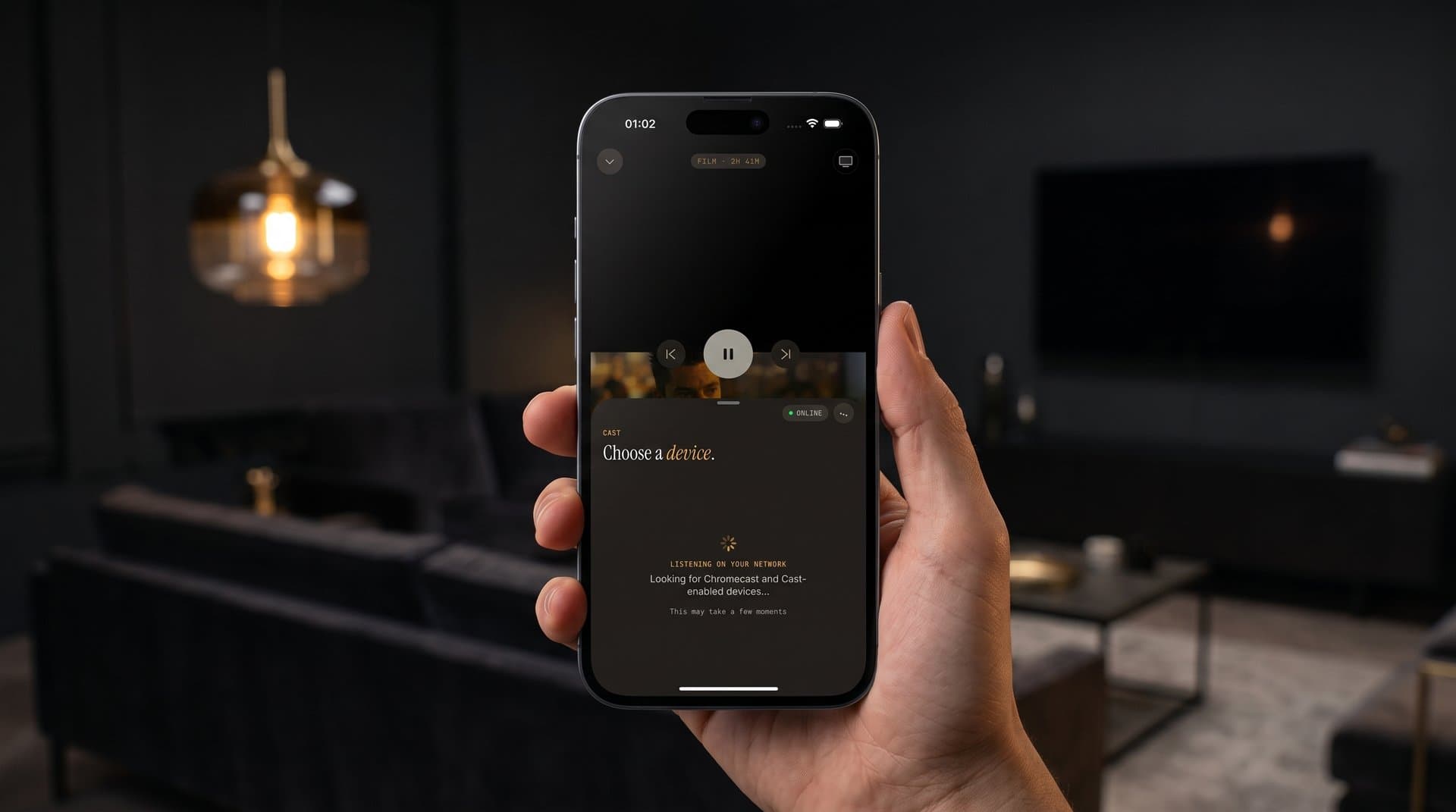
4K, HLS, and Buffer-Free Playback: How Maximus IPTV Player Delivers a Better Picture
Ask any cord-cutter what actually makes an IPTV app worth keeping, and the answer usually isn't the channel count — it's whether the picture holds up. Maximus IPTV Player is built around that idea: buffer-free streaming and true 4K playback aren't marketing lines tacked onto a features list, they're the plumbing the rest of the app depends on. This guide breaks down what "quality" really means in an IPTV context, the two technical formats doing the heavy lifting behind the scenes, and how Maximus IPTV Player is engineered to keep the picture clean whether you're watching on an iPhone, an iPad, an Android tablet, or casting to the TV.
Key Takeaways
- Maximus IPTV Player supports 4K playback alongside buffer-free streaming, so picture quality depends on your source and connection, not the app adding extra lag.
- Two playlist formats — M3U and M3U8 — sit underneath almost every IPTV setup, and Maximus IPTV Player reads both without extra configuration.
- HLS (HTTP Live Streaming) is the delivery method that lets a stream adjust and keep playing smoothly instead of stalling outright.
- Casting the picture to a bigger screen works two ways on iOS — AirPlay and Chromecast — while Android relies on Chromecast; AirPlay is Apple-only.
- The app is free to download, with an optional premium subscription, and runs on iPhone, iPad, Apple TV, Android phones, Android tablets, and Android TV / Google TV — one app, one subscription, every screen.
What Actually Determines IPTV Picture Quality?
IPTV picture quality comes down to three things stacked on top of each other: the quality of the source stream itself, the format that stream is packaged in, and how well the player on your device handles that format under a real-world, sometimes-imperfect connection. A player app can't upgrade a low-bitrate source into something it isn't — but it can absolutely make a good source look worse through poor buffering logic, clunky format support, or a playback engine that chokes the moment your Wi-Fi dips for a second.
This is where Maximus IPTV Player's job really lives. The app is built to support 4K playback so that when your playlist or Stalker Portal source is delivering a high-resolution stream, nothing in the app itself is capping or degrading it. At the same time, buffer-free streaming is designed to keep video moving smoothly rather than freezing every time network conditions shift slightly — the two features work together, not separately.
How Does Maximus IPTV Player Handle 4K Playback?
4K refers to Ultra HD resolution — roughly four times the pixel count of standard 1080p Full HD — and it's one of the headline features Maximus IPTV Player supports across both platforms. Whether you're watching on iPhone, iPad, Apple TV, an Android phone, an Android tablet, or Android TV / Google TV, the app is built to play back 4K content when your source provides it.
A useful mental model: think of 4K support as the ceiling, and your source stream as what actually fills that ceiling. If your IPTV subscription or M3U playlist provides a 4K stream, Maximus IPTV Player is built to display it at full resolution. If the source itself is only 1080p or lower, no player can invent extra detail — but you also won't lose anything the source has to offer, since the app isn't the bottleneck.

What Is HLS, and Why Does It Matter for Buffer-Free Streaming?
HLS (HTTP Live Streaming) is the delivery technology behind most modern IPTV and video streaming — it's the protocol that breaks a stream into small segments so a player can request the next chunk smoothly instead of downloading one giant continuous file. This is the mechanism that underpins buffer-free streaming: because the content arrives in short segments, a well-built player can keep a short runway of upcoming video ready to go, so a brief network hiccup doesn't necessarily mean a frozen screen.
This matters most in exactly the situations IPTV viewers actually run into: a router shared with three other devices, a mobile hotspot on a moving train, or an apartment where the Wi-Fi signal gets thinner three rooms from the router. Buffer-free streaming isn't a guarantee against every possible network condition — no app can promise that — but it's the design goal Maximus IPTV Player is built around: play smoothly by default, and recover gracefully rather than freezing outright when conditions aren't perfect.
M3U vs. M3U8: Does Your Playlist Format Affect Picture Quality?
If you've spent any time setting up an IPTV app, you've run into these two terms. M3U is a plain-text playlist format that simply lists stream URLs and channel names — it's the format that's been around the longest and is still the most common way IPTV providers hand you a channel lineup. M3U8 is the UTF-8 encoded version of the same idea, and in practice it's the format most closely associated with HLS-based streams specifically.
The good news: neither format determines picture quality on its own — they're both just the map, not the terrain. What matters is the actual stream quality behind each URL in the list. Maximus IPTV Player reads both M3U and M3U8 sources without requiring you to convert anything, and if your provider also uses a Stalker Portal (a different provider-hosted delivery method some IPTV services use instead of a playlist file), that's supported too. The practical upshot: whichever format your subscription hands you, getting it into Maximus IPTV Player isn't the part that affects what you see on screen — your source's actual stream quality is.

Does Casting Change the Picture You See? AirPlay vs. Chromecast
Watching on a phone screen and watching on a TV are different experiences, and casting is how Maximus IPTV Player bridges the two. On iOS, the app supports both AirPlay and Chromecast (Google Cast) — AirPlay is Apple's own casting protocol and only works between Apple devices, while Chromecast is not Android-exclusive and works from the iPhone and iPad apps too. On Android, Chromecast is the casting method available. Either way, the app isn't re-encoding or compressing the picture for the cast — it's handing off the same stream to a bigger screen.
If you'd rather skip the phone-to-TV handoff entirely, Android TV and Google TV are now supported directly, alongside Apple TV on iOS — meaning the app runs natively on the TV itself rather than only casting to it. That's true for phones, tablets, and TVs on Android, all from the same app on Google Play, and iPhone, iPad, and Apple TV on the Apple App Store.
How Does the EPG Fit Into a Smooth Viewing Experience?
EPG stands for Electronic Program Guide — the on-screen schedule that shows you what's airing now and what's coming up next across your channels, similar to the guide grid on a traditional cable box. It's not a video-quality feature by itself, but it's part of the same experience: knowing what's on without channel-surfing blind means less time spent flipping around and more time actually watching a clean, buffer-free stream. Maximus IPTV Player's EPG is built to work alongside 4K and buffer-free playback rather than as a separate bolt-on screen.
FAQ
Does Maximus IPTV Player support 4K on Android as well as iOS? Yes — 4K playback is supported across both platforms: iPhone, iPad, and Apple TV on iOS, and Android phones, tablets, and Android TV / Google TV on Android, all from the same app.
Will Maximus IPTV Player upscale a low-quality stream to 4K? No app can genuinely add detail that isn't in the source. Maximus IPTV Player is built to play back whatever resolution your source stream provides, up to and including 4K — it won't degrade a good source, but it also can't invent quality a source doesn't have.
What's the difference between M3U and M3U8 for my setup? M3U8 is the UTF-8 encoded version of the M3U playlist format, most often associated with HLS streams. Functionally, Maximus IPTV Player reads both without any extra setup on your end — you don't need to convert one to the other.
Can I cast from an iPhone to a non-Apple TV? Yes, via Chromecast — the iOS app supports both AirPlay (Apple-only) and Chromecast (not Android-exclusive), so an iPhone can cast to a Chromecast-enabled TV as easily as to an Apple TV via AirPlay.
Is Maximus IPTV Player free? Yes — it's free to download, with an optional premium subscription available for anyone who wants it.
Getting a Cleaner Picture, Wherever You Watch
Good IPTV playback isn't one feature — it's 4K support, HLS-based buffer-free streaming, flexible M3U/M3U8 and Stalker Portal compatibility, and casting that doesn't get in its own way, all working together instead of competing for resources. That's the combination Maximus IPTV Player is built around, across every screen it runs on: phone, tablet, TV, and everything in between.
If you're on iPhone, iPad, or Apple TV, Maximus IPTV Player is available now on the Apple App Store. If you're on Android — phone, tablet, or Android TV / Google TV — it's on Google Play. Same app, same subscription, same commitment to a picture that stays clean instead of stalling out.
Written by
Maximus IPTV Team