Combining Every IPTV Source in One App: How Multi-Source Management Works in Maximus IPTV Player
Most people who cut the cord don't end up with one source of channels — they end up with three or four. A Live IPTV subscription from one provider. An M3U playlist a friend shared. Maybe a Stalker Portal login from a reseller. The channels are all legal, all the user's own subscriptions — but they're scattered across logins, apps, and menus. Maximus IPTV Player was built to collapse all of that into a single combined library, and today we're walking through exactly how its multi-source management works, on both iPhone and Android.

Key Takeaways
- Maximus IPTV Player lets you add more than one source — a Live IPTV service and an M3U/M3U8 playlist, for example — and view them together in one combined library instead of switching apps.
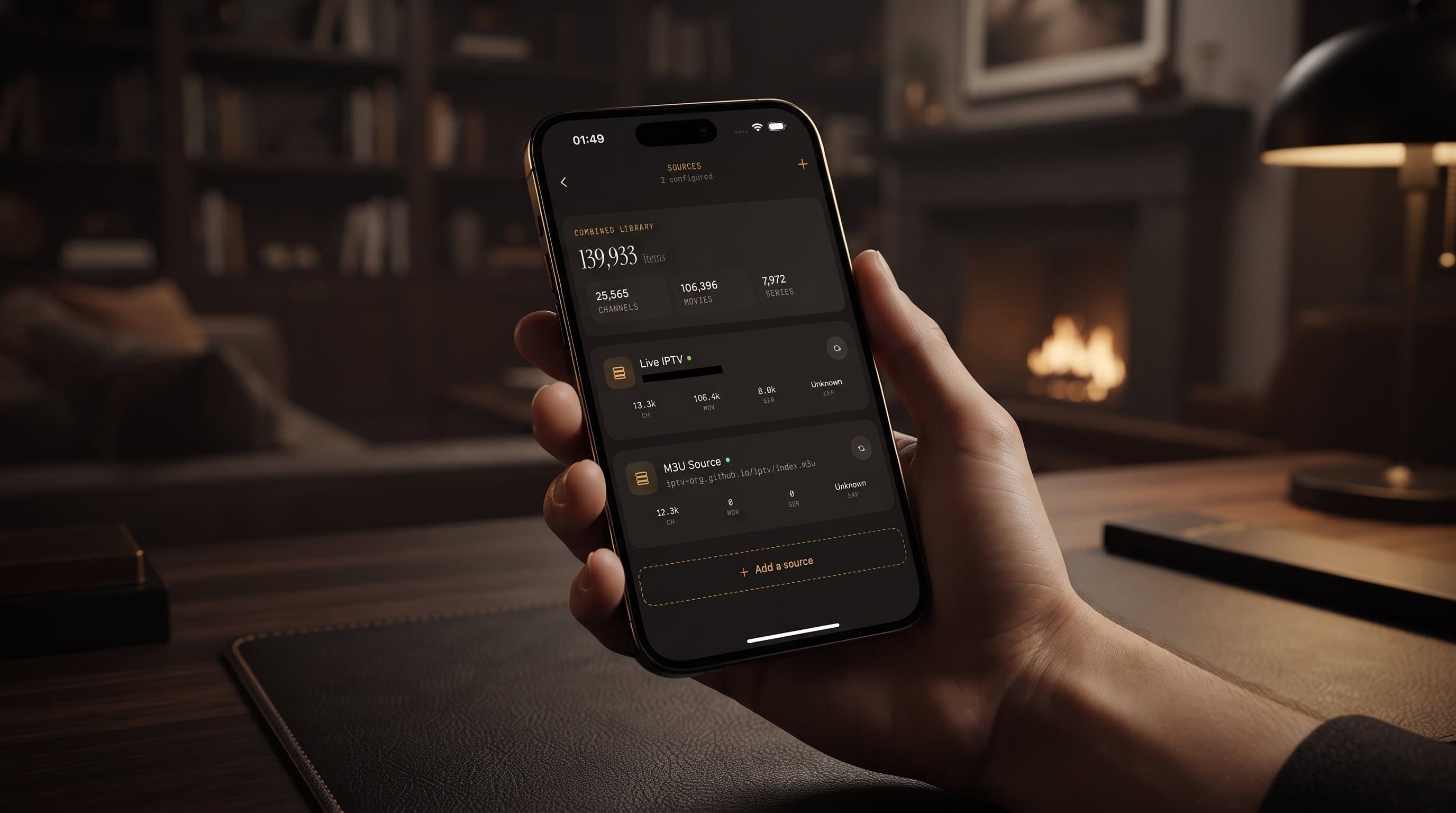
- The Sources screen shows combined library stats up front, so you can see everything you've connected at a glance.
- Supported source types include Live IPTV subscriptions, M3U/M3U8 playlists, and Stalker Portal logins.
- The app is free to download on the Apple App Store (iPhone, iPad, Apple TV) and Google Play (Android phones, tablets, and Android TV / Google TV), with an optional premium subscription.
- No ads, no tracking — multi-source management doesn't change that.
What Does "Multi-Source" Actually Mean in an IPTV App?
In plain terms, a "source" is anywhere your channels or on-demand content actually come from. That might be a Live IPTV provider you pay monthly, a free M3U playlist someone sent you, or a Stalker Portal a reseller set up for you. Most IPTV apps make you pick one source and stick with it, or force you to bounce between separate apps if you have more than one.
Maximus IPTV Player takes a different approach. Open the Sources screen and you'll see a "Combined Library" summary at the top — a single set of stats covering everything you've added — followed by a list of your individual connections, labeled things like "Live IPTV" and "M3U Source," with an "Add a source" button to bring in more. You're not choosing between them. You're stacking them.

How Do You Add a Live IPTV Service to Maximus IPTV Player?
If your provider gave you a username, password, and a portal URL (sometimes called an Xtream Codes-style login), that's a Live IPTV source. From the Sources screen, tap "Add a source," choose the Live IPTV option, and enter those three details. Maximus IPTV Player pulls in the channel list, electronic program guide (EPG) data, and any video-on-demand catalog the provider makes available, then folds all of it into your combined library alongside anything else you've added.
What About M3U and M3U8 Playlists — How Do Those Fit In?
M3U is a plain-text playlist format that lists channel names alongside their stream addresses — think of it as a simple index file rather than a full app. M3U8 is the same idea, but formatted for HLS (HTTP Live Streaming), the segmented streaming protocol most modern IPTV and video services actually use under the hood. If you have a playlist URL — or even a local .m3u file — you add it the same way: "Add a source," paste the URL or import the file, and Maximus IPTV Player parses it into channels, groups, and (where the provider supplies one) EPG data, right next to your Live IPTV entries.
This matters because plenty of cord-cutters end up with exactly this combination: a paid Live IPTV subscription for the bulk of their channels, plus a free or niche M3U playlist for a handful of extras. Without multi-source support, that's two apps. With it, it's one Sources screen and one library.
What Is a Stalker Portal, and Does Maximus IPTV Player Support It?
A Stalker Portal is a middleware system some IPTV resellers use to manage subscriber access — instead of a plain playlist URL, you get a portal address plus a MAC-address-style login the provider issues you. It's common enough among IPTV resellers that any serious player app needs to support it, and Maximus IPTV Player does: it's the third source type alongside Live IPTV and M3U/M3U8, addable from the same screen with the same "one library" result.
Why Combine Everything Into One Library Instead of Switching Apps?
The practical answer is search and favorites. Maximus IPTV Player's universal search reaches across every source you've connected — so searching for a show doesn't mean checking your Live IPTV app, then your M3U app, then remembering which one actually had it. Favorites and Continue Watching work the same way: a channel or series you've favorited stays favorited regardless of which source it came from, and Resume Watching picks up where you left off without you needing to remember where you started.
There's also a simpler, less obvious benefit: one buffer-free streaming engine handling playback for all of it, instead of three different apps with three different players, three different remote-control layouts (on Apple TV or Android TV / Google TV), and three different sets of parental control settings to configure separately.
Does Multi-Source Management Slow Anything Down?
No — adding a second or third source doesn't mean Maximus IPTV Player has to juggle multiple video engines at once. Playback, buffering behavior, and 4K support are the same regardless of which source a given channel or title came from; the multi-source layer sits at the library and navigation level; below that layer, the app is playing one stream through one player, one screen at a time. The combined library view is essentially a smarter index — a way of presenting everything together — not a resource-hungry layer running underneath every video.
Is This Available on Both iPhone and Android?
Yes. Multi-source management is a core feature of Maximus IPTV Player, not a platform-specific add-on. It works the same way on iOS — iPhone, iPad, and Apple TV, all downloadable from the Apple App Store — and on Android, where Maximus IPTV Player ships as a single app (package com.aegontech.maximus) covering Android phones, tablets, and Android TV / Google TV from one Google Play listing. Add a Live IPTV service and an M3U playlist on your iPhone, and you'll find the same Sources screen and the same combined-library approach if you also install Maximus IPTV Player on an Android tablet or Android TV — each device manages its own sources independently, since Maximus IPTV Player doesn't currently sync source lists across devices.
Casting also carries over cleanly: AirPlay is available on iOS for sending playback to a TV or speaker, and Chromecast (Google Cast) is available on both iOS and Android — so however your sources are organized, getting the picture onto a bigger screen works the same way everywhere.
What About Privacy — Is Any of This Tracked?
Maximus IPTV Player doesn't run ads and doesn't track usage. Adding multiple sources means the app stores your connection details (locally, per source) so it can pull in channels and EPG data — that's the same handling any IPTV player needs to actually connect to a provider. It doesn't change the no-ads, no-tracking posture of the rest of the app.
FAQ
How many sources can I add to Maximus IPTV Player? The Sources screen is built to hold more than one — the "Combined Library" summary and per-source list (Live IPTV, M3U Source, and so on) are designed around having several active at once, not just a single connection.
Do I need a premium subscription to add multiple sources? Maximus IPTV Player is free to download, with an optional premium subscription. Your own Live IPTV, M3U, or Stalker Portal subscriptions are separate — you're bringing your own legal content sources into the app either way.
Will my favorites and Continue Watching mix up content from different sources? No — favorites and Resume Watching are tied to the specific channel or title, not to which source it came from, so everything surfaces correctly no matter how many sources are connected.
Can I remove a source later without losing the others? Yes, sources are added and managed individually from the Sources screen, so removing one doesn't affect your other connections or your combined library setup for the rest.
Does multi-source support work the same on Android TV and Apple TV as it does on phones? Yes — the Sources screen and combined-library approach are the same app experience across phone, tablet, and TV on both platforms; only the remote-driven navigation on Apple TV and Android TV / Google TV differs, not the underlying source management.
Getting Your Sources Into One Place
If you're currently switching between two or three apps to cover a Live IPTV subscription, an M3U playlist, and maybe a Stalker Portal login, that's exactly the problem multi-source management in Maximus IPTV Player is meant to solve. One Sources screen, one combined library, one search bar that actually reaches everything.
Maximus IPTV Player is free to download for iPhone, iPad, and Apple TV on the Apple App Store, and for Android phones, tablets, and Android TV / Google TV on Google Play.
Written by
Maximus IPTV Team