The Cord-Cutter's First Week: Setting Up Maximus IPTV Player From Scratch
Switching away from cable is easy to decide and, for a lot of people, surprisingly awkward to actually do. You uninstall the old set-top box, you have a playlist link or a provider login sitting in an email somewhere, and then you're staring at an empty app wondering what to tap first. This guide is the walkthrough we wish existed on day one: a practical, no-fluff plan for your first week with Maximus IPTV Player, the cross-platform IPTV player available free on both the Apple App Store (iPhone, iPad, and Apple TV) and Google Play (Android phones, tablets, and Android TV / Google TV) — one app, one download, every screen in the house. It's a player, not a content provider: everything you watch comes from your own legal IPTV subscription or playlist, and this guide keeps every step that way.
Key Takeaways
- Maximus IPTV Player is free to download on both the Apple App Store and Google Play, with an optional premium subscription — no piracy, no bundled channels, just a player for the sources you already have.
- Day one is about adding your source (M3U, M3U8, or Stalker Portal) and letting the app build a combined library — this alone usually takes under 10 minutes.
- The Home screen, live EPG, and Universal Search are built to get you to "something to watch" fast, without digging through folders.
- Casting works with both AirPlay and Chromecast on iOS, and Chromecast on Android — so the phone setup and the living-room setup are the same one-time job.
- Parental controls take under a minute to configure and are worth doing in week one, before anyone else in the house starts exploring the library.
- Favorites, Resume Watching, and offline downloads are the three features that make week two feel like you've been using it for months.
What Do You Actually Need Before You Download Maximus IPTV Player?
Before you install anything, gather two things: your device (an iPhone, iPad, Apple TV, Android phone, Android tablet, or an Android TV / Google TV device all work) and your source information — the actual playlist or portal details from your own IPTV provider. Maximus IPTV Player doesn't supply channels or content itself; it's the interface that organizes and plays whatever legal source you point it at. If you don't have that information handy, it's worth pausing here and getting it from your provider first, because step two depends on it.
Also worth knowing before you start: Maximus is a genuine every-screen app. On iOS, the same app runs on iPhone, iPad, and Apple TV. On Android, Google Play now covers phones, tablets, and Android TV / Google TV from the same app package — so whichever screen you start on, the app you're learning this week is the same app you'll use everywhere else.
How Do You Add Your First IPTV Source?
This is the one step everything else depends on, and it's simpler than it sounds. Open Maximus IPTV Player, go to Sources, and add your provider's details in one of three common formats:
- M3U — a plain-text playlist file listing your channels and streams by URL. The most common format IPTV providers hand out.
- M3U8 — functionally the same idea as M3U, but built for HLS (HTTP Live Streaming), the streaming protocol most live-TV playback uses today. If your provider gives you an ".m3u8" link, this is what that means.
- Stalker Portal — a different delivery method some providers use, where instead of a static playlist file you log into a portal endpoint with credentials, and the app pulls your channel list, EPG, and VOD library from there dynamically.

Once a source is added, Maximus indexes it and folds it into what the app calls your combined library — live channels, movies, and series from every source you've added, browsable in one place instead of switching between separate apps or logins. If you have more than one provider, or a friend shares a second playlist, add it the same way: multi-source management means you're not choosing one source at the expense of another, you're combining them.
What Should You Actually Watch First?
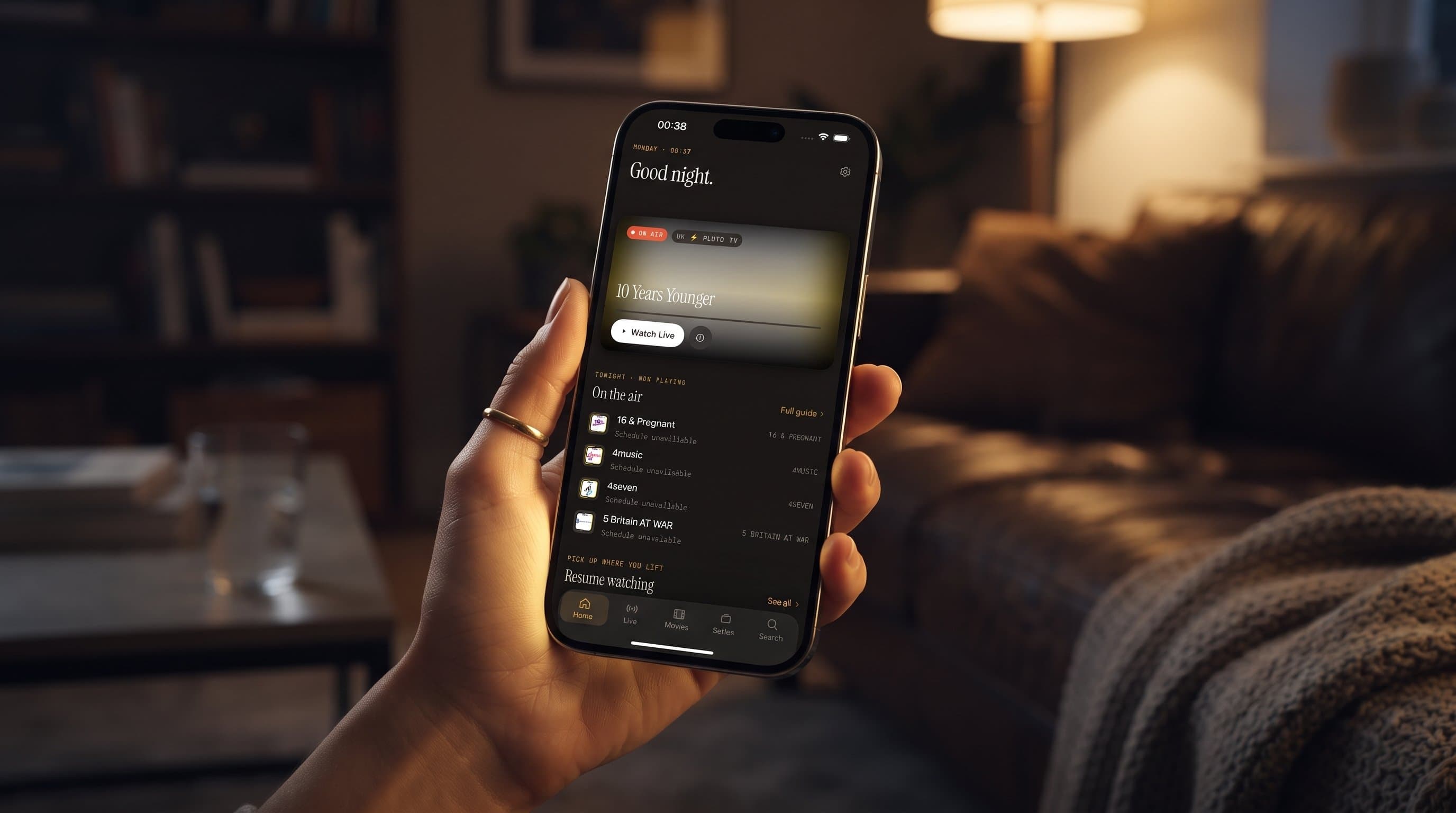
Once your source finishes indexing, the Home screen is where you'll land, and it's designed to answer "what's on right now?" before you've typed a single search. You'll see an on-air hero card for whatever's currently live and popular in your library, a "Tonight" list of what's playing across your channels, and a Resume Watching row once you've started anything. It's a genuinely fast way to get from "app just opened" to "watching something" in the first few minutes.
For anything more specific, the EPG (Electronic Program Guide) is the other tool worth learning immediately — a timeline grid showing what's airing now and later across every channel you've added, filterable by Favorites, Sports, Movies, or Kids. If you know roughly what you want but not which channel it's on, Universal Search covers that instead, searching across your Movies and Series library at once so you're not guessing which section to browse.
How Do You Get Maximus IPTV Player Onto Your TV?
You don't need a second, TV-specific setup for this. If you're on Android TV or Google TV, you already installed the TV-native version from the same Google Play listing, with an interface built for a remote instead of a stretched phone screen. If you're watching from a phone or tablet on either platform, casting handles the living room instead: Maximus supports both AirPlay and Chromecast (also called Google Cast) on iOS, and Chromecast on Android. Worth being precise about this, because it trips people up — AirPlay is Apple's own casting protocol and only works from Apple devices; Chromecast is not Android-exclusive and works from an iPhone or iPad just as well as from an Android phone. Tap the cast icon, pick your TV or streaming device from the list, and playback hands off without restarting anything.
Should You Set Up Parental Controls in Week One?
Yes — and it's a one-screen job, so there's no reason to put it off. Maximus IPTV Player's Parental Lock sits under a dedicated setting where you set a PIN and confirm it once; from then on, adult content categories require that PIN to open. It doesn't require an account, an email, or any setup beyond the PIN itself.

If kids or other family members are going to be using the same device or the same TV, this is a five-minute step that's much easier to do before the library is in daily use than after. It also pairs naturally with organizing channels into groups on day one — country filters and channel groups make the library easier for everyone in the house to browse on their own, adults and kids alike.
What About Offline Downloads and Multiple Devices?
By week two, two more features tend to matter: offline downloads and using the app across more than one screen. Episodes in your Series library show a per-episode download option, so you can save something to watch without a connection — useful for a commute, a flight, or just a spotty connection at home. And because the same app runs on iPhone, iPad, Apple TV, Android phones, tablets, and Android TV / Google TV, you can set up your source once and use it from whichever device is nearest, with Favorites and Resume Watching carrying over the habits you build in week one. (To be precise: Maximus doesn't currently offer synced subscription sharing across separate accounts — each install works from the source you add on that device.)
Common First-Week Hiccups
A couple of small issues account for most early troubleshooting questions. Buffering or freezing right after setup is almost always a connection issue between your source and the app, not the app itself — check the source is indexing correctly under Sources before assuming something's broken. A blank or "no signal" channel is usually a stream URL issue at the provider level rather than a Maximus setting. And if 4K playback looks softer than expected, it depends entirely on what resolution your source is actually delivering — Maximus supports 4K, but it can't upscale a lower-resolution stream into something it isn't.
Frequently Asked Questions
Is Maximus IPTV Player free? Yes, it's free to download on both the Apple App Store and Google Play, with an optional premium subscription for extra features. There's no cost to try it with your existing source.
Does Maximus provide channels or IPTV subscriptions? No. Maximus is a player app — you bring your own legal M3U, M3U8, or Stalker Portal source, and the app organizes and plays it. This guide doesn't cover finding a source, only setting up the one you already have.
Can I use Maximus on my phone and my TV at the same time? Yes — the same app supports iPhone, iPad, and Apple TV on iOS, and Android phones, tablets, and Android TV / Google TV on Android, and you can add your source and use it from any of them.
Does casting work from an iPhone to a non-Apple TV? Yes. Chromecast (Google Cast) works from the iOS app, not just Android — it isn't limited to Apple devices the way AirPlay is limited to Apple's own ecosystem.
How long does the whole first-week setup actually take? Adding your source and getting the combined library indexed typically takes under 10 minutes. Parental controls take under a minute. The rest — Favorites, channel groups, downloads — is optional polish you can add gradually rather than all at once.
Getting Started
The honest version of "first week" advice is that most of it fits into the first ten minutes: add your source, let Maximus IPTV Player build your combined library, and set a parental PIN if you need one. Everything else — Favorites, EPG habits, casting to the living room — tends to happen naturally once the basics are in place. Maximus IPTV Player is free to download for iPhone, iPad, and Apple TV on the Apple App Store, and for Android phones, tablets, and Android TV / Google TV on Google Play.
Written by
Maximus IPTV Team