M3U vs M3U8 vs Stalker Portal: IPTV Source Types Explained
If you've ever added a playlist to an IPTV app and ended up staring at a blank channel list, you've probably run into the confusing alphabet soup of IPTV source types. Maximus IPTV Player is a free-to-download, cross-platform IPTV player — available on the Apple App Store for iPhone, iPad, and Apple TV, and on Google Play for Android phones, tablets, and Android TV / Google TV — and it can juggle several different kinds of sources at once. But "juggle several kinds of sources" only works well if you actually know what those source types are and why Maximus IPTV Player treats them differently under the hood. This guide breaks down M3U, M3U8, and Stalker Portal in plain language, shows how Maximus IPTV Player handles each one, and walks through adding, combining, and troubleshooting sources so your channels and EPG data actually show up the way they should.
Key Takeaways
- Maximus IPTV Player supports three common IPTV source formats: M3U, M3U8, and Stalker Portal — and you can combine more than one inside a single Combined Library.
- M3U and M3U8 are both playlist files; M3U8 is the more modern variant built specifically for HLS-based streaming.
- Stalker Portal is a completely different system — a login-based middleware server, not a downloadable file — and Maximus IPTV Player connects to it directly.
- Once a source loads, Maximus IPTV Player's EPG (Electronic Program Guide) and Live TV screens populate automatically from that source's channel and schedule data.
- Universal Search in Maximus IPTV Player works across every source you've added, so you don't have to remember which playlist a channel or show lives on.
What Do M3U, M3U8, and Stalker Portal Actually Mean?
Before touching the Sources screen in Maximus IPTV Player, it helps to know what you're actually adding. These three terms cover the vast majority of legal IPTV setups people bring to the app from their own subscription or self-managed playlist.
M3U is a plain-text playlist file format that's been around since the days of early MP3 players. In the IPTV world, an M3U file is essentially a list of channel names paired with stream URLs and metadata (like a logo or a group/category label). It's the original, most widely supported playlist format, and most IPTV providers still offer it as an export option.
M3U8 is M3U's modern sibling. It's structurally similar — still a plain-text list — but it's the format associated with HLS (HTTP Live Streaming), the adaptive-bitrate streaming protocol Apple introduced that's now an industry standard. Streams referenced in an M3U8 playlist are built to adjust quality on the fly based on your connection, which is part of why M3U8-based sources tend to handle spotty Wi-Fi or cellular data more gracefully than older M3U-only setups.
Stalker Portal is a different animal entirely. Instead of a single downloadable file, it's a middleware server system — you connect Maximus IPTV Player to a portal URL along with a MAC address or login credentials, and the portal serves up the channel list, EPG, and stream links dynamically every time you connect. Because it's server-driven rather than file-based, a Stalker Portal source can update its own channel lineup without you ever touching a file again.
None of these formats determine what content you're watching — Maximus IPTV Player is a player, not a content provider, and every source above assumes you're pointing the app at your own legal IPTV subscription or playlist.
How Does Maximus IPTV Player Handle Multiple Source Types at Once?
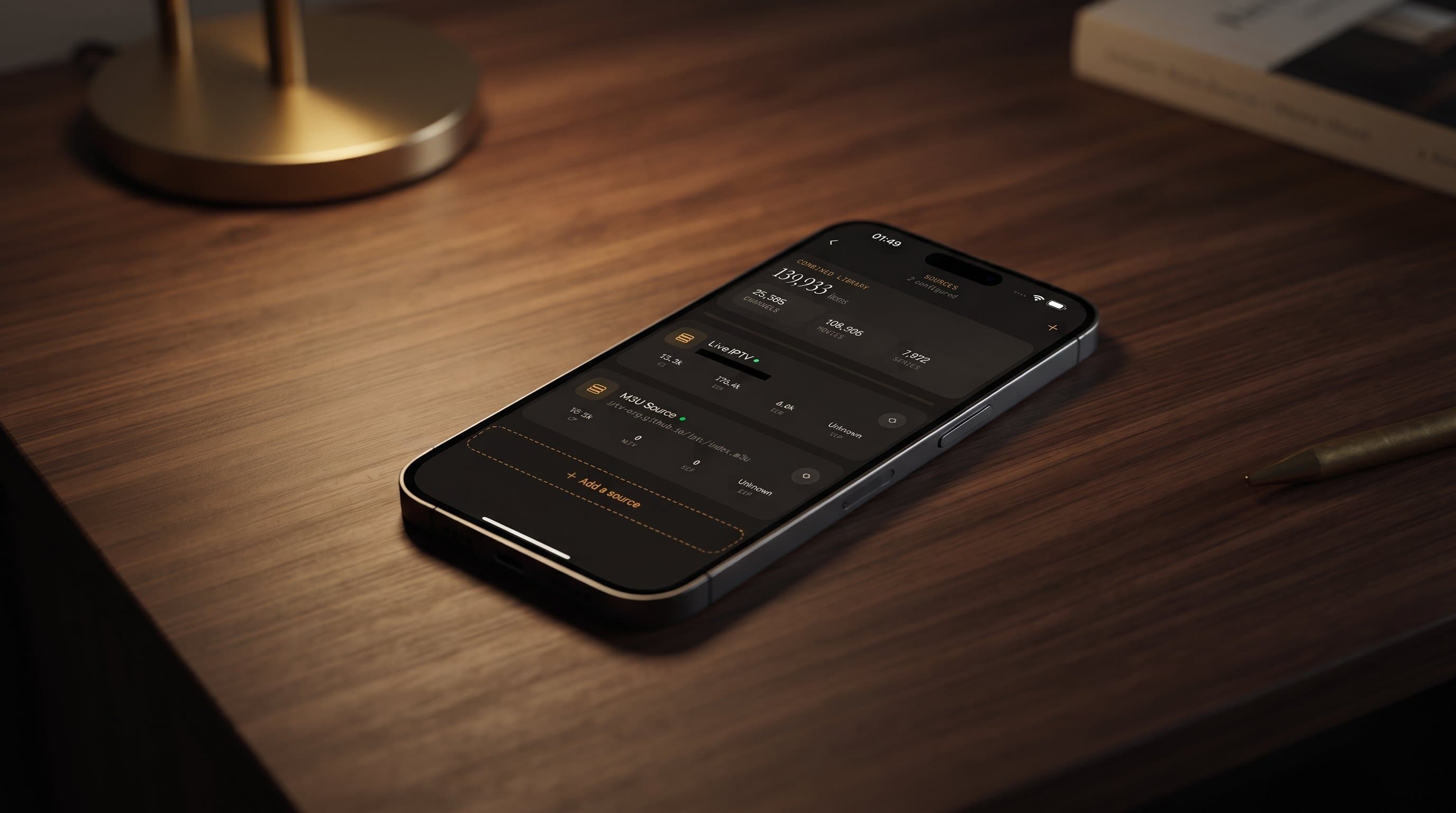
This is where Maximus IPTV Player's Sources screen earns its keep. Rather than forcing you to pick one format and stick with it, the app's Combined Library merges channels and on-demand content from every active source — M3U, M3U8, and Stalker Portal alike — into one unified Live TV list, one search index, and one Home screen. Add an M3U playlist from one provider and a Stalker Portal login from another, and Maximus IPTV Player treats them as a single library rather than two separate silos you have to switch between.
That matters most for people who've accumulated more than one source over time: maybe an M3U8 playlist for international channels and a Stalker Portal login for local sports packages. Instead of opening two apps, you open Maximus IPTV Player once.
Which Source Type Should You Use?
There's no universally "best" format — the right choice depends entirely on what your provider gives you. Here's how the three compare in practice:
- M3U — Simplest to set up (just a URL or local file). Works everywhere. Best when your provider only offers a basic playlist export and you don't need dynamic EPG updates baked into the source itself.
- M3U8 — Same simplicity as M3U, but built around HLS adaptive streaming. A good pick when your provider explicitly hands you an
.m3u8link, since it typically means smoother playback on inconsistent connections. - Stalker Portal — More setup steps upfront (portal URL plus MAC address or credentials), but the payoff is a channel list and EPG that update themselves server-side. Best if your provider specifically issues Stalker Portal credentials rather than a playlist file.
If your provider gives you a choice, there isn't a wrong answer among these three — Maximus IPTV Player is built to handle all of them equally well inside the same Combined Library.

How Do You Add a New Source in Maximus IPTV Player?
From the Sources screen, adding a source follows the same basic pattern regardless of type: choose "Add a source," select whether it's an M3U/M3U8 playlist or a Stalker Portal connection, and enter the details your provider gave you — a playlist URL for M3U/M3U8, or a portal URL plus MAC address/login for Stalker Portal. Maximus IPTV Player validates the connection, pulls down the channel and metadata list, and adds it to your Combined Library stats right on that same screen, so you can see at a glance how many live channels and on-demand titles just came in.
A few practical tips that save people the most headaches:
- Double-check the URL for typos before saving — a single dropped character in an M3U8 link is the single most common cause of a source failing to load.
- If your provider gave you a Stalker Portal MAC address, copy it exactly, including colons — Maximus IPTV Player needs an exact match to authenticate.
- Give a newly added Stalker Portal source a minute or two after saving; because it's pulling live data from a remote server rather than reading a local file, the very first sync can take longer than an M3U import.
What Happens After You Add a Source?
Once a source is active, Maximus IPTV Player automatically populates two of its core screens from that source's data. Live TV fills in with channel groups — often organized by country, so a source covering the UK, Turkey, Germany, and Brazil will show up as four distinct country filters you can flip between. The EPG (Electronic Program Guide — the scrollable schedule grid showing what's airing now and later on each channel) builds its timeline directly from the same source, complete with the orange "now" indicator line and category tabs like Sports, Movies, and Kids.
If a source only partially loads — say, channels show up but the guide stays empty — that almost always means the provider's feed includes stream links but not full EPG metadata, which is a provider-side limitation rather than something wrong with Maximus IPTV Player itself.
Can You Search Across All Your Sources at Once?
Yes — and this is one of the more underused features once you've combined a couple of sources. Maximus IPTV Player's universal search runs across your entire Combined Library, so a single query surfaces matching results from Movies, Series, and Live TV regardless of which source they came from, complete with result-count tabs so you can jump straight to the category you want. If you've ever forgotten which of two playlists actually carries a particular channel or show, this is the screen that saves you from manually checking each source one at a time.

Troubleshooting: Why Isn't My Source Loading?
Most source problems in Maximus IPTV Player — or any IPTV player, honestly — trace back to one of a handful of causes:
- Expired or incorrect credentials. Both M3U8 links and Stalker Portal logins are usually tied to an active subscription; an expired provider account will fail to load even though the source is entered correctly.
- Network restrictions. Some networks or ISPs throttle or block certain streaming traffic. If a source loads fine on Wi-Fi but fails on cellular (or vice versa), that's a strong signal to check with your provider about whether a VPN (Virtual Private Network — a service that routes your connection through a different server, often used to work around network-level restrictions) is recommended for their service.
- A stale playlist URL. M3U and M3U8 links occasionally change on the provider's end. If a source worked last month and suddenly returns nothing, re-copying the current URL from your provider is worth trying before assuming anything else is wrong.
Frequently Asked Questions
Can I use more than one source type at the same time in Maximus IPTV Player? Yes. You can add any combination of M3U, M3U8, and Stalker Portal sources, and Maximus IPTV Player merges them into a single Combined Library rather than requiring you to switch between them.
Is Stalker Portal more secure than an M3U playlist? Not inherently — the two differ in how they deliver data (a live server connection versus a static file), not in encryption or security by default. Either can be secure or insecure depending entirely on how your provider runs it.
Do I need different sources for iOS and Android? No. Maximus IPTV Player reads the same M3U, M3U8, and Stalker Portal source types whether you're on an iPhone, iPad, Apple TV, an Android phone or tablet, or Android TV / Google TV — the underlying source format doesn't change by platform.
Why does my EPG show some channels but not others from the same source? This usually means the provider's feed supplies schedule data for some channels but not all of them. It's a common limitation of the source itself rather than something you can fix from within the app.
Does adding more sources slow down Maximus IPTV Player? Combining a reasonable number of sources shouldn't meaningfully affect performance, since the Combined Library indexes everything for fast search and browsing rather than re-loading each source from scratch every time you open the app.
Getting the Most Out of Your Sources
Understanding the difference between M3U, M3U8, and Stalker Portal isn't just trivia — it's the difference between a five-minute setup and twenty minutes of guessing why a channel list won't populate. Maximus IPTV Player is built to treat all three as first-class citizens inside one Combined Library, complete with unified EPG, Live TV, and universal search, so the format your provider hands you shouldn't dictate how good your experience is.
Maximus IPTV Player is free to download with an optional premium subscription, and it's available now on the Apple App Store for iPhone, iPad, and Apple TV, and on Google Play for Android phones, tablets, and Android TV / Google TV. Whichever source type your provider gives you, it's ready to go.
Written by
Maximus IPTV Team