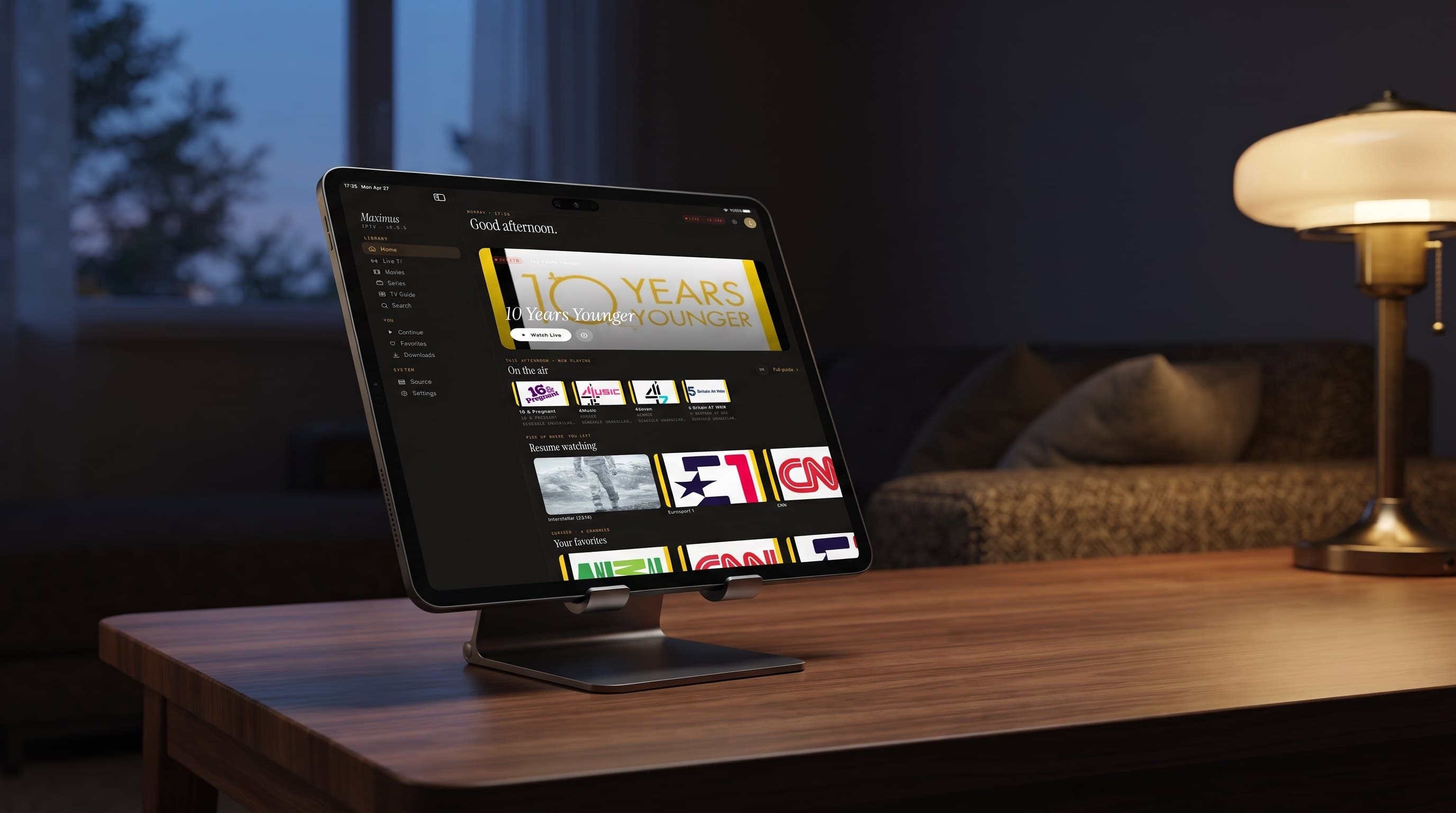
Using Maximus IPTV Player on iPad: A Big-Screen Setup Guide
Most IPTV setup walkthroughs are written with a phone in mind — a tall screen, one thumb, a single column of channels. But Maximus IPTV Player looks and behaves differently on an iPad, and if you've only ever seen screenshots from an iPhone, you're missing the version of the app that's actually built for your living room coffee table. Maximus IPTV Player is a free-to-download, cross-platform IPTV player available on the Apple App Store for iPhone, iPad, and Apple TV, and on Google Play for Android — and the iPad edition swaps the phone's single-column layout for a persistent sidebar, a widescreen EPG grid, and a setup flow that takes real advantage of the extra screen space. This guide walks through what changes, how to set it up, and when an iPad actually makes more sense than an Apple TV for the same content.
Key Takeaways
- Maximus IPTV Player on iPad uses a persistent left-sidebar layout instead of the iPhone's bottom tab bar, so Home, Live TV, Movies, Series, TV Guide, Search, Sources, and Settings are all one tap away at all times.
- The EPG (Electronic Program Guide — the scrollable schedule grid showing what's airing now and next) spans far more channel rows and time columns on iPad than it can on a phone.
- Parental Lock on iPad supports Face ID / Touch ID unlocking in addition to a PIN, which is a genuinely different (and faster) experience than typing a passcode on a phone.
- Source setup — adding an M3U playlist, an M3U8 link, or a Stalker Portal connection — is one Sources screen away in the sidebar, with combined library stats shown at a glance.
- Casting from iPad works over both AirPlay (Apple's screen-mirroring and media-casting protocol, iOS/iPadOS only) and Chromecast (Google's casting protocol, also called Google Cast, which works from iOS and Android alike) — so an iPad can throw a channel to almost any TV in the house.
What actually changes when Maximus runs on iPad?
The short answer: navigation and density. On iPhone, Maximus IPTV Player is built around a bottom tab bar and single-column lists, because there simply isn't room for anything else. On iPad, the app switches to a fixed sidebar on the left — Home, Live TV, Movies, Series, TV Guide, Search under a "Library" heading, then Continue, Favorites, and Downloads under "You," and Sources and Settings under "System." Every section is visible and reachable at once, without ever backing out of a screen. If you've used Maximus on a phone and found yourself tapping back-and-forth between tabs, the iPad version removes almost all of that friction.
The home screen itself also gets roomier: a greeting, a large on-air hero card for whatever's live right now, a horizontal "On the air" row of currently playing channels, and a "Resume watching" row for picking up where you left off — all visible together on one screen instead of requiring a scroll.
How do you set up Maximus IPTV Player on your iPad?
- Download Maximus IPTV Player from the Apple App Store — it's free, with an optional premium subscription for extended features.
- Open the app and go to Sources in the sidebar under "System."
- Add your playlist. Maximus supports three source types: an M3U file (a plain-text playlist format that lists channel names alongside their stream URLs), an M3U8 link (the same idea, but the extension usually signals an HLS — HTTP Live Streaming — stream, which is the standard Apple and most modern players use for adaptive-quality video), or a Stalker Portal connection (a server-based IPTV middleware protocol some providers use instead of a flat playlist file, authenticated with a portal URL and login credentials rather than a single link).
- Once added, the Sources screen shows your Combined Library stats — how many channels, movies, and series are pulled in across every source you've added — so multi-source users can see everything at a glance instead of guessing.
- Head back to Home or Live TV and your channels are ready to browse.
This whole flow takes a couple of minutes, and because the Sources screen is a permanent sidebar item rather than buried in a settings menu, adding a second or third source later is just as fast as the first one.

How does the EPG look different on a bigger screen?
The EPG is the single biggest quality-of-life upgrade on iPad. On a phone, a program guide can really only show you a handful of channels and an hour or two of schedule before you're scrolling constantly. On iPad, the TV Guide view lays out dozens of channel rows down the left and a much wider time axis across the top, with an orange "now" line marking the current moment as it moves across the grid. Favorites, All, Sports, Movies, and Kids filter tabs sit right at the top of the guide, so you can narrow a crowded grid down to just the channels you care about without leaving the screen.
If you split your time between international channel groups — Maximus organizes live channels with country filters, so a UK, Turkey, Germany, or Brazil grouping is one tap away — the wider grid means you can actually see what's coming up across several countries' schedules at once, instead of guessing from a title alone.
How do parental controls work, and what's different on iPad?
Maximus IPTV Player includes a built-in Parental Lock, and on iPad it supports Face ID or Touch ID unlocking as an alternative to typing a PIN every time. Setup is straightforward: from Settings, enable Parental Lock, set a PIN (with a confirmation step), and optionally toggle on Face ID / Touch ID so that Maximus can use the same biometric unlock your iPad already relies on elsewhere. Once enabled, the app shows "Protection is on" with a clear Enabled status, a Change PIN option, and a visible toggle for the biometric shortcut — you can always fall back to the PIN if Face ID doesn't read (sunglasses, low light, whatever the reason).
For a household iPad that gets handed to kids for cartoons while adults are in another room, being able to unlock adult content with a glance rather than remembering a shared PIN is a small thing that matters in practice.

How does casting work from an iPad?
Maximus IPTV Player supports both AirPlay and Chromecast (Google Cast) casting, and — this is worth being precise about, because it's a common point of confusion — both protocols are available on the iOS app, not just AirPlay. AirPlay is Apple's own casting and screen-mirroring protocol and only works with AirPlay-compatible receivers (an Apple TV, or an AirPlay 2-enabled smart TV). Chromecast, on the other hand, is Google's protocol, but it isn't limited to Android devices — the Maximus iOS app can cast to any Chromecast-connected TV or Chromecast-enabled smart TV just as easily as it can AirPlay to an Apple TV. Practically, that means an iPad running Maximus can send live TV or a downloaded episode to almost any TV in the house, regardless of which casting standard that TV happens to support.
iPad or Apple TV: which should you actually use?
Both run the same Maximus IPTV Player experience from the same Apple App Store listing, and neither is strictly "better" — they're suited to different moments. An Apple TV, plugged into your actual living room television, is the right call when you're settled in to watch: no casting step, no second device to manage, and full-screen from the start. An iPad is the better tool everywhere else: in the kitchen while you cook, propped up in a hotel room, or handed to a kid in the back seat with a downloaded episode already saved for offline viewing. Because the app and your source setup carry across every Apple device once you're signed in with the same Sources configured, switching between the two isn't really an either/or decision — most Maximus households end up using both, for different rooms and different moments of the day.
FAQ
Does Maximus IPTV Player cost anything on iPad? No — it's a free download from the Apple App Store, with an optional premium subscription for users who want extended features. There's no cost just to install it and connect your own playlist.
Can I use the same M3U or Stalker Portal source on both my iPad and my iPhone? Yes — Sources are configured per-device inside the app, so you'd add the same playlist URL or Stalker Portal credentials on each device you use, the same way you would set up any IPTV source.
Does the iPad app show ads? No. Maximus IPTV Player is built with no ads and no tracking, on iPad exactly as on iPhone and Android.
What video quality does Maximus support on iPad? Maximus IPTV Player supports 4K playback where your source stream provides it, subject to your own connection and the quality of the playlist or portal you've connected.
Is there a separate Android tablet version of this guide? Yes — Android tablets use Google Play rather than the App Store, and the interface differs slightly; that's covered in a dedicated Android tablet guide elsewhere on this blog.
Getting started
If you've only used Maximus IPTV Player on a phone, the iPad version is worth a second look — the sidebar navigation, the wide EPG grid, and Face ID-protected parental controls all take advantage of the extra screen in ways a phone simply can't. Maximus IPTV Player is free to download on the Apple App Store for iPhone, iPad, and Apple TV — connect your own M3U, M3U8, or Stalker Portal source and the same library, favorites, and downloads follow you across every Apple screen you own.
Written by
Maximus IPTV Team