No Ads, No Tracking: Why Maximus IPTV Player Puts Your Privacy First
No Ads, No Tracking: Why Maximus IPTV Player Puts Your Privacy First
Most "free" apps pay their bills with your attention or your data — banner ads between every tap, background trackers quietly logging what you watch and when. Maximus IPTV Player takes a different approach: it's a free-to-download, cross-platform IPTV player with no ads and no tracking, built on the simple idea that a media player's job is to play your media, not mine your habits. If you've ever closed an app because a pop-up interrupted a match at the worst possible moment, this is the post for you.

Key Takeaways
- Maximus IPTV Player has zero ads and zero trackers on both iOS and Android — confirmed directly on the app's own store listings.
- It's free to download on two major app stores: the Apple App Store (iPhone, iPad, Apple TV) and Google Play (Android phones, tablets, and Android TV / Google TV), with an optional premium subscription.
- The app works with your own legal IPTV sources — M3U, M3U8, or a Stalker Portal connection — so Maximus never has a catalog of "its" content to monetize with ads in the first place.
- A single PIN code locks down parental controls locally on your device — no account, no cloud profile required.
- The same privacy-first design runs across six screen types: iPhone, iPad, Apple TV, Android phone, Android tablet, and Android TV.
Why does an IPTV app need ads or tracking at all?
Most consumer apps are free because something else pays for them. Usually that's advertising, and advertising works best with data: what you watch, how long you watch it, what time of day, what device, sometimes even location. For a service that streams video for hours at a stretch — sports, movies, international news — that adds up to a very detailed picture of someone's evening.
Maximus IPTV Player sidesteps that model. The app is free to download, with an optional premium subscription for anyone who wants it, but the base experience isn't subsidized by selling attention or behavioral data. That's a meaningfully different business relationship than the typical ad-supported streaming app, and it shows up in the product itself: no banner ads interrupting your EPG (electronic program guide — the on-screen schedule showing what's airing now and next), no pre-roll ads before you hit play, no "recommended for you" modules quietly built from a tracking profile.

How does "bring your own source" reduce tracking exposure?
Here's a detail that's easy to miss: Maximus IPTV Player isn't a content service. It's a player. You connect it to your own legal IPTV subscription or playlist using one of three source types — an M3U playlist (a plain-text file listing stream URLs), its close cousin M3U8 (the same idea, formatted for HLS, or HTTP Live Streaming, the standard used by most modern IPTV providers), or a Stalker Portal connection (a login-based IPTV middleware format common with subscription providers). Multiple sources can be added and combined into one library.
Because Maximus doesn't operate the underlying content catalog, it has no built-in reason to log what channel or show a stream URL points to in order to sell that data onward. The app's job stops at rendering your source cleanly — with 4K playback where the source supports it, subtitle and multi-audio track support for international content, and a universal search that works across everything you've added. Compare that to an all-in-one streaming app that both owns the catalog and needs to justify a free tier — the incentive structure is completely different, and that's before you even look at a privacy policy.
Does "no tracking" mean no parental controls?
No — and this is worth being precise about, because the two are often conflated. Parental controls in Maximus IPTV Player are local: a PIN-protected lock that a parent sets directly in the app to keep adult content out of reach. Setting it up takes entering a new PIN, confirming it, and hitting Enable — there's no account creation, no cloud-synced child profile, no third-party service checking in. The control lives on the device, which is a more privacy-respecting shape for the feature than a system that phones home every time a kid opens the app.
What does "no ads, no tracking" look like day to day?
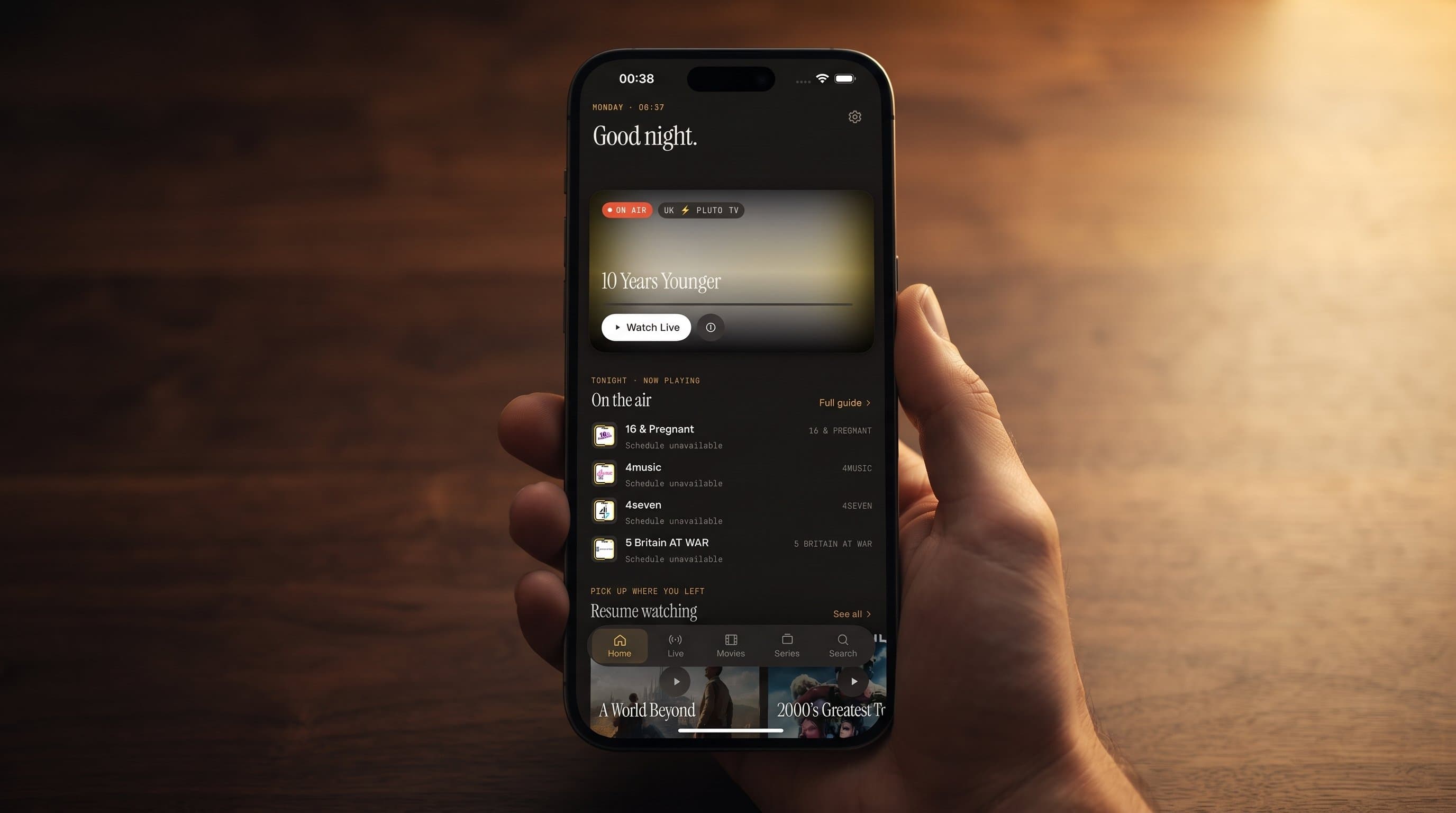
In practice, it's mostly about what you don't notice. The home screen greets you with your on-air content and a "Continue watching" row built from your own resume-playback history — stored for your convenience, not shipped off to build an ad profile. Casting to a TV works over AirPlay (Apple's screen-mirroring and casting protocol, iOS/Apple TV only) or Chromecast (Google's casting standard, sometimes called Google Cast, available on both the iOS and Android versions of Maximus) without an ad interrupting the handoff. Favorites and channel organization by country persist locally so your setup stays yours.
It also means the app doesn't need a VPN (virtual private network — a tool some IPTV users pair with their provider for security or access reasons) to feel private in normal use, since Maximus itself isn't the thing doing the watching. A VPN is about protecting your connection to your IPTV provider; Maximus's no-ads/no-tracking design is about what the player app itself does with your activity once you're inside it. They're solving different problems, and it's worth not conflating them when you're evaluating your overall setup.
Is this the same experience on iOS and Android?
Yes, by design. Maximus IPTV Player launched on the Apple App Store first, covering iPhone, iPad, and Apple TV, and later shipped the same no-ads, no-tracking design to Android via Google Play — phones and tablets first, with Android TV / Google TV following from the same app build. Whichever store you download from, the core promise doesn't change: no ads, no trackers, and the same 4K playback, EPG, parental lock, and multi-source management either way. The Android TV build uses a native remote-driven interface built for the living room rather than a stretched phone layout, but the privacy model underneath is identical.
FAQ
Does Maximus IPTV Player cost anything? It's free to download on both the Apple App Store and Google Play, with an optional premium subscription for anyone who wants additional features. The base app is not ad-supported.
Does Maximus collect data about what I watch? Maximus is a player for your own legal IPTV sources — it isn't operating a content catalog it needs to build advertising profiles around, and the app carries no ads or trackers.
Do I still need my own IPTV subscription? Yes. Maximus IPTV Player is a player app, not a content provider. You connect your own legal M3U, M3U8, or Stalker Portal source, and Maximus handles playback, organization, EPG, casting, and parental controls on top of it.
Can I use parental controls without creating an account? Yes. The PIN-based parental lock is set and stored locally on the device — no account or cloud profile is required.
Is casting available on both iOS and Android? Chromecast (Google Cast) works on both the iOS and Android versions of Maximus. AirPlay is an Apple technology and is only available on iOS and Apple TV.
Ready to try it?
If a cluttered, ad-interrupted streaming experience has worn you out, Maximus IPTV Player is worth a look. On iPhone, iPad, or Apple TV, download it free from the Apple App Store. On Android phones, tablets, or Android TV / Google TV, get it free on Google Play. Same app, same no-ads-no-tracking promise, every screen.
Written by
Maximus IPTV Team